Get Full Government Meeting Transcripts, Videos, & Alerts Forever!
Get email alerts on the Neighborhood Watch topic
No spam. Unsubscribe anytime.
Oregon City Police outline neighborhood-watch program and officer liaison support
Summary
Oregon City Police presented a three-step Neighborhood Watch program to the Citizen Involvement Committee, outlining organization, training and maintenance steps and offering officer liaisons, signage and training support for residents who want to form or reactivate watch groups.
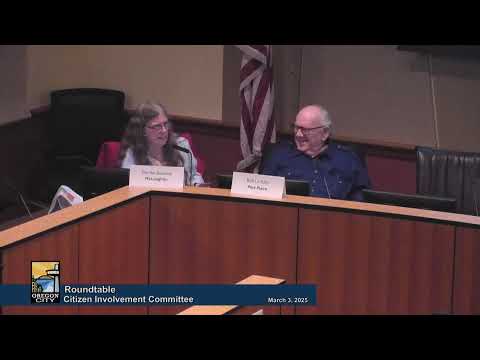
Oregon City Police on March 3 gave the Citizen Involvement Committee (CIC) an overview of a Neighborhood Watch program that the department says is centered on resident participation together with assigned officer liaisons.
The department described the program as a three-step process: organize a watch and appoint a coordinator, receive training from an assigned officer liaison and assign duties and maintain the group. Patty Stewart of the police department said the liaison will schedule training, follow up with the group and help tailor the program to a neighborhood’s needs.
Police officials said the program’s benefits include reduced risk of becoming a victim of crime, quicker reporting and information sharing about local trends. Stewart said the department provides blue-and-white watch signage placed by public works within city code requirements and suggested additional deterrents such as window decals for home security systems.
During the question-and-answer period, residents and CIC members asked how to find an existing liaison and how many active watch groups the department currently supports. Stewart said the department helped establish two active groups in recent years (one in Park Place and one in Hazel Grove) and is working to re-engage others. She said residents can look up their neighborhood association by address on the city website or contact her directly to identify the liaison and begin training.
Police emphasized reporting specifics to dispatch—location, descriptions, vehicle direction of travel—and advised calling 911 when a situation appears to be an emergency. Stewart said she maintains a contact list and will check in with active groups periodically to provide materials and guidance.
The presentation included references to training materials from the National Neighborhood Watch and National Neighborhood Watch Institute and an offer from the department to help neighborhoods start or reactivate watch groups with tailored training. No formal action or vote was recorded; the presentation was informational and committee members discussed outreach and signage options afterward.