Get Full Government Meeting Transcripts, Videos, & Alerts Forever!
Get email alerts on the Urban Renewal topic
No spam. Unsubscribe anytime.
Oregon City urban renewal commission debates legal challenge, ballot and closure options over Charter Section 59
Summary
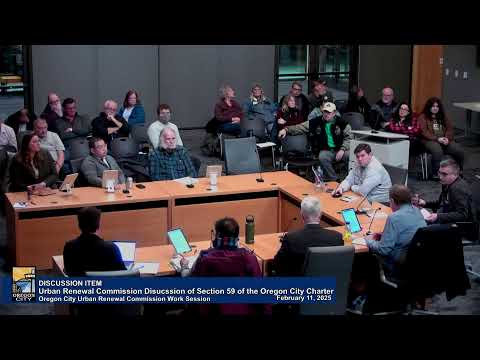
At a Feb. 11 work session the Oregon City Urban Renewal Commission discussed whether to seek a court validation, place new ballot measures, close and reopen the district, or pursue other steps after part of Charter Section 59 was found preempted by state law.
Oregon City Urban Renewal Commission members on Feb. 11 discussed a range of options — including filing a court validation, putting new ballot measures before voters, or closing and recreating the district — after staff reported that portions of Section 59 of the Oregon City Charter have been held preempted by state law.
The discussion matters because the commission oversees tax-increment financing for downtown and other redevelopment areas and the district currently generates about $3,200,000 a year in increment. Staff told the commission the agency holds roughly $9,000,000 in cash that is not currently being used and that closing the district and returning increment to taxing jurisdictions would yield about $900,000 in new revenue to the City of Oregon City general fund.
City staff presented background from prior ballot measures and court decisions and mapped the practical constraints in the charter. “E has been found to be unenforceable. So e isn’t part of 59 anymore,” City staff member Bill Conkle said, referring to the subsection added by voters in 2016. Staff also explained the charter’s definition of “bonded indebtedness” effectively bars entering agreements that create payment obligations extending more than one year without a voter-approved measure. “If you enter into an agreement that’s more than one year, even with cash on hand, that triggers a vote,” Conkle said.
Commissioners and members of the public pressed staff on specific scenarios. A commissioner asked whether the agency could use funds to redirect a stormwater line through property at 12th and Main within a one-year contract period; staff said such a project could be allowed under the charter if it fit the urban renewal plan and did not create obligations beyond one year. Staff also estimated a validation suit to clarify Section 59’s remaining enforceability could take as little as two to three months but more likely about six months, and might run longer if parties intervened.
Public commenters were split. Dorothy Dalser said she supports urban renewal but objected to removing voter control: “I voted for urban renewal. I’m a strong believer in urban renewal, but in these times when we’re losing so many rights and so many right to vote, I cannot give up one little right to give up my vote.” James Neceta warned against using taxpayer funds for litigation to remove voter rights and urged alternatives, saying a court fight “will last into the 2026 election” and could deepen public division. William Gifford and John Lewis urged the commission to seek legal clarity; Gifford said, “If there is an opportunity where we aren’t certain of the legality of a particular action, it’s incumbent upon us to find clarity regarding its legality,” while Lewis favored a validation suit as a neutral way to resolve the uncertainty.
Commissioners discussed several options set out in the staff report: place a new ballot measure authorizing the agency to assume debt for specified projects; place a ballot measure to rescind Section 59 entirely; close the current district and distribute assets and increment to taxing districts; close the district and create a new one with a reset frozen base; pursue declaratory relief seeking a court ruling that the remainder of Section 59 is preempted; or take actions and then file a validation suit to have a court determine the regularity and legality of those actions. Staff noted the commission previously placed a measure on the May 2024 ballot to authorize debt; that measure failed.
Commissioners expressed a mix of priorities: several said they want legal clarity before approving projects that would require multi‑year contracts or borrowing; others emphasized restoring momentum on redevelopment and suggested placing a targeted, smaller ballot measure tied to one or two shovel‑ready projects as a way to build community trust. Several commissioners supported a facilitated dialogue between proponents and opponents of the charter language to build consensus and avoid further polarization before pursuing large proposals.
The commission reached consensus on next steps to return the matter to a public regular meeting for further public comment and deliberation, and asked staff to provide more information on the implications of closing and reopening the district, the mechanics and likely timeline of a validation suit or declaratory judgment, and examples of guardrails the commission could include in a measure or plan. Commissioners asked staff to schedule a facilitated community dialogue about Chapter 59 after the commission has legal clarification. The commission did not take any formal votes at the work session; staff emphasized that formal actions occur only at future public meetings.
The commission indicated it will set a date and length for a follow-up public meeting and that written comment will remain an option for residents. No final decisions were made at the Feb. 11 work session.