Get Full Government Meeting Transcripts, Videos, & Alerts Forever!
Get email alerts on the Planning Appointments topic
No spam. Unsubscribe anytime.
Oregon City commissioners interview planning commission candidates; lean toward appointing economic development officer
Summary
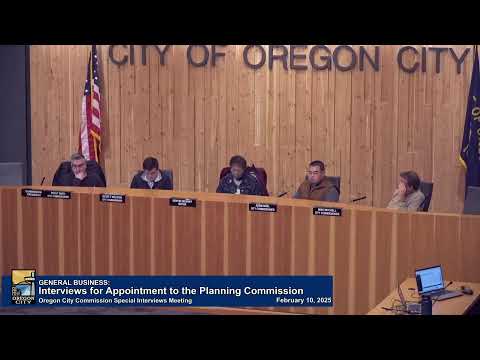
At a Feb. 10 special meeting, the Oregon City City Commission interviewed three candidates for a vacant planning commission seat and signaled a preference to appoint Victoria Meinek, an economic development officer, pending a formal vote at the next available meeting.
Oregon City commissioners held a special meeting Feb. 10 to interview applicants for a vacancy on the Planning Commission and signaled a preference for appointing Victoria Meinek to fill the full term vacated by Daphne Weston, though a formal motion and vote were deferred to the next available meeting.
The Planning Commission advises the City Commission on land-use policy, code updates and certain development applications; the commission typically meets the second and fourth Mondays of each month at 7 p.m. Mayor Denise McGriff opened the meeting by describing the interviews as “your volunteer job application and your volunteer job interview.” The commissioners emphasized familiarity with planning work, the need to review staff reports and occasional site visits when applications arise.
Meinek, who told commissioners she is the economic development officer at the Business Resource Center of South Clackamas County and chair of the Downtown Oregon City Association, described completing a certified economic developer program and serving on the courthouse committee. “I’ve been focusing on land use planning processes, real estate cycles, brownfield information and making sure there’s site-ready land,” Meinek said. Commissioners said her background in economic development would add a perspective not always represented on the Planning Commission.
Applicant Robert Green, a retired general contractor who said he held an active general contractor license for 47 years and currently serves on the Historic Review Board, said he would bring a construction perspective to deliberations. Candidate Lane Elmer, a residential real estate agent with about 10 years of experience and a veteran of the U.S. Marine Corps and Oregon National Guard, said his time in real estate gives him practical experience looking up code interpretations and working with property owners.
Commissioners and current and former commissioners used the interviews to discuss the two main functions of the Planning Commission: advising on broader planning and policy (legislative work) and evaluating specific applications against existing codes (quasi-judicial work). Commissioners repeated that quasi-judicial decisions must be based on the codes and ordinances in effect, while advisory work allows more discretionary consideration of public input and policy goals.
Several commissioners urged applicants to do substantive pre-meeting work: staff reports generally are provided at least one week before hearings, and commissioners said they commonly review reports, check for late public comment on hearing days, contact staff ahead of meetings with technical questions, and, when practical, visit sites that are the subject of applications. “We always make time for staff if you have questions,” said former Planning Commissioner Mike Mitchell, noting staff reports are “usually pretty detailed and pretty thorough.”
Commissioners also discussed appointment process and outreach. While the panel expressed a clear preference for Meinek — “I was really impressed with Victoria,” Commissioner Adam said — they flagged a procedural concern: the special meeting notice had gone public only the day before, and a formal appointment requires a motion and vote at a properly posted meeting. Staff advised the first opportunity for a formal motion would be the next Wednesday meeting; commissioners agreed to bring the appointment back for a vote then.
The meeting included broader reflections on recruitment: several commissioners said many applicants appear motivated to “get involved” but lack a clear understanding of the time commitments and substantive work expected by boards and commissions. Commissioners suggested improving online postings and application materials to describe duties, typical time commitments and the technical reading required for Planning Commission members.
With no formal motion taken on Feb. 10, the commission adjourned and plans to take the appointment up at the next scheduled meeting where a motion and vote will be required to finalize the selection.