Get Full Government Meeting Transcripts, Videos, & Alerts Forever!
Get email alerts on the Homelessness Response topic
No spam. Unsubscribe anytime.
Local faith group pitches ‘Built for Zero’ stabilization center; council directs staff to pursue follow-up
Summary
Representatives from U-turn for Christ and Path Partners described a stabilization center and a Built for Zero approach to reduce homelessness; the council voted to direct staff to coordinate with the organizers and bring the idea back to council.
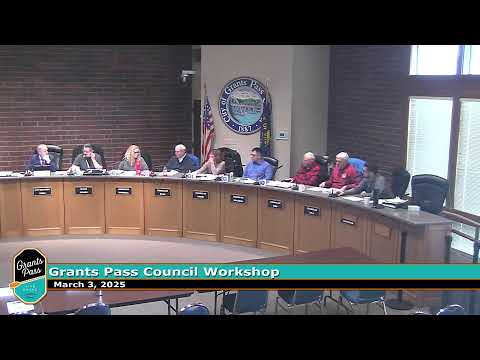
Representatives of U-turn for Christ and Path Partners presented the Built for Zero model to the Grants Pass City Council workshop and asked the city to participate in planning a stabilization center that would provide short-term housing, medical and behavioral-health intake, case management and vocational supports.
Jeremy, who represented U-turn for Christ, said Built for Zero “uses real time data to track and respond to homelessness” and described a stabilization center with “24/7 staffing, temporary housing, and access to services” including on-site medical and mental health supports. Julie Thomas of Path Partners joined the presentation to describe coordination with local nonprofits and faith-based groups.
Presenters argued the model moves communities from crisis management to systematic reduction of homelessness by creating a coordinated, data-driven system. Jeremy said the initiative relies on real-time data sharing across providers and technical support from Community Solutions; he noted many local nonprofits already enter information into the Homeless Management Information System (HMIS) but that Built for Zero brings agencies together to use the data collectively. Jeremy told the council that, with a dedicated site, organizers believed they could have a stabilization center “up and running within 45 to 60 days.”
Asked about funding and governance, Jeremy said U-turn for Christ would likely place the project under a separate 501(c)(3) and form a board; he listed potential national and philanthropic partners and said recent state-level funding proposals exist. He said the group had discussed possible funding with Home Depot Foundation, Quicken Loans and local trusts and had raised the pending state proposal for shelter funding (identified in the presentation as bill 3644, with a referenced allocation of $217,000,000). Jeremy said the group planned steering and subcommittees and expected Community Solutions to provide technical assistance.
Councilors and staff pressed on operational details: whether faith-based involvement would hamper public funding (Jeremy said the center would operate under a separate charitable entity and that faith-based services would not be mandatory), how other nonprofits would partner (presenters said MET, AllCare, Gospel Rescue Mission and Calvary Chapel leadership had participated in planning conversations) and whether the model would use real-time lists and shared goals (presenters said yes and pointed to examples in Rockford, Illinois; Bakersfield, California; Gulfport, Mississippi and Chattanooga, Tennessee).
Councilor Victoria moved to direct staff to communicate with Jeremy about Built for Zero so the project can be brought to council for further consideration; Councilor Rick seconded. The motion passed by roll call vote with the seven council members recorded as voting in favor (Seth — yes; Rob — yes; Joel — yes; Eric — yes; Kathleen — yes; Rick — yes; Victoria — yes).
Next steps identified in the presentation and the motion: staff will coordinate follow-up meetings with the organizers, identify stakeholders, and assemble further operational and funding details for future council discussion. Presenters asked the city to consider a site within the urban growth boundary and to explore state and federal grant opportunities in order to avoid adding new utility or property-tax burdens on residents.
The presenters also screened and discussed a short video case study of Rockford, Illinois, where presenters said Built for Zero helped the community reduce veteran and chronic homelessness.
Because the motion directs staff to open discussions and return with more information, any future action (site selection, funding commitments or contractual arrangements) will require separate council approval.