Get Full Government Meeting Transcripts, Videos, & Alerts Forever!
Get email alerts on the Homelessness Camping Sites topic
No spam. Unsubscribe anytime.
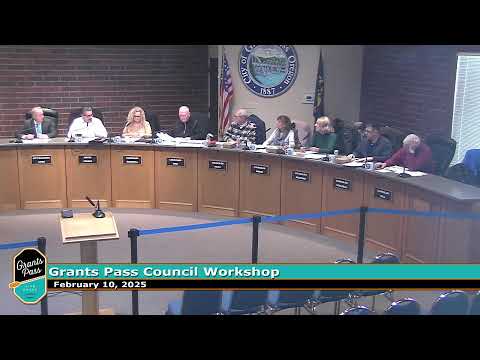
Grants Pass narrows potential temporary camping sites to four as city seeks to address court order
Summary
City staff presented potential sites for temporary camping/resting and ADA compliance; council narrowed options to four locations and directed staff to consult legal counsel about time, manner and next steps in response to an existing temporary restraining order related to enforcement against public resting.
At a Grants Pass City Council workshop, staff briefed the council on potential designated resting/camping locations for people experiencing homelessness as the city seeks to respond to a temporary restraining order and litigation over whether its rules are “objectively reasonable” under state law. Councilors narrowed an initial list of properties to four sites and asked staff to consult city legal counsel and schedule an executive session to discuss time-related limits.
City staff member Aaron introduced the discussion as a review of past, current and potential sites and framed the workshop as informational: “This is not an all inclusive list… and call to action today would be any direction council may be able to provide with regards to future camping sites,” he said. Aaron reviewed past sites (6th & 8th Street, J Street) and the city’s current site at 712 Northeast Seventh Street, which he said is 0.32 acres and has porta‑potties, dumpster, handwashing and some services.
The council discussed the legal context. A counselor summarized the litigation background: the city changed its camping exclusions on Jan. 7, was sued, and a judge placed a temporary restraining order on enforcement; the city has an opportunity to propose adjustments to the judge that could lead to withdrawal of the restraining order while the underlying case proceeds. Council and staff said legal counsel estimated the case could take roughly one to three years to resolve. Mayor Clint and staff emphasized that the workshop’s goal was to identify additional space the city could offer to show “objectively reasonable” time, place and manner under House Bill 3115 and related state law.
Aaron presented a list of potential sites, both city‑owned and privately held. City‑owned sites discussed included 712 NE Seventh Street (current site, 0.32 acres), 3284 Foothill Boulevard (three parcels totaling about 16 acres; outside city limits; unimproved), 850 East Park Street (unpaved, flat), a former hospital parking area at 124 NW Midland (roughly a half‑acre paved area), and 601 SE I Street (0.3 acres, fenced and graded but not paved). Privately held parcels discussed included 2660 NW Vine Street (about 0.78 acres, zoned Industrial Park just outside the city limits; presented as a potential navigation/stabilization center location) and a larger industrial parcel shown in the presentation (tax assessor value referenced later in discussion).
Aaron provided cost and service figures for existing operations: through Nov. 24 the city had incurred roughly $156,000 in costs related to sites and cleanup. He said larger sites averaged about $2,100 per month for porta‑potties, smaller sites about $1,100; garbage service ranged roughly $900–$1,200 per month; and weekly cleanup and administrative costs rise with the number of sites. He noted that the Seventh Street site would likely need paving to meet ADA accessibility standards and recommended paving as a priority if the city kept it on the list.
Councilors weighed tradeoffs: sites near police facilities (712 NE Seventh Street) are easier and less costly to monitor; large, remote, unimproved sites (example: Foothill Boulevard parcels) would require substantial investment to meet ADA standards and likely would be less useful in negotiations with the court; and industrial parcels (2660 NW Vine Street) have potential for a navigation center but raise issues about future industrial land supply and nearby residential neighborhoods. Police Chief Hensman said proximity to normal patrol routes and visibility influence monitoring needs; he described very large, unwieldy sites as harder to manage.
After discussion and sequential elimination votes on a longer list, councilors identified four sites to keep in play for staff and legal review: 712 NE Seventh Street (current city site), 2660 NW Vine Street (private parcel proposed as a possible navigation center), 124 NW Midland (former hospital parking area with paved sections), and 601 SE I Street (city‑owned graded/fenced lot). Councilors removed smaller or more problematic parcels (J Street, Riverside/Riverside West Park area, certain Foothill parcels, one Park Street parcel) from the short list. Mayor Clint and staff said Aaron will take these four sites to the city attorney for guidance and suggested scheduling an executive session to discuss time limits and legal implications.
Councilors also agreed to table further discussion of specific time limits (hours and permitted durations) to an executive session with legal counsel present. Staff said time limits and manner of regulation could be discussed in executive session to preserve attorney‑client privilege and to get direct legal guidance on how changes could affect the city’s court position. The mayor directed staff to coordinate with legal counsel and return with options.
The workshop closed without a formal ordinance change. Councilors emphasized the temporary nature of city‑run sites and the value of partnering with nonprofit providers for longer‑term navigation or stabilization services.