Get Full Government Meeting Transcripts, Videos, & Alerts Forever!
Get email alerts on the Homelessness Campsites topic
No spam. Unsubscribe anytime.
Council designates two temporary sites and a 96‑hour limit for outdoor resting amid judge’s order
Summary
Facing a temporary restraining order and a lawsuit, the council designated two sites — 712 Northeast Seventh Street (adjacent to police) and a Sixth Street site — where people may rest/camp for up to 96 hours; the resolution passed 6–1 after extensive public comment and debate.
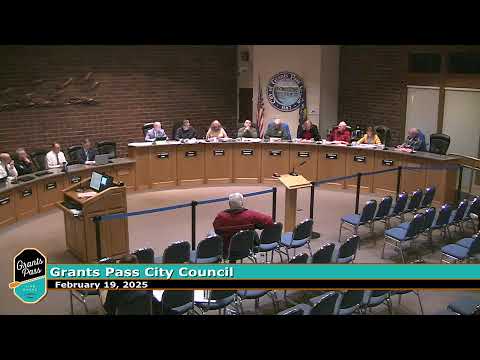
The Grants Pass City Council, responding to a temporary restraining order in litigation over enforcement of the city’s camping rules, designated two temporary sites where people may rest or camp for up to 96 hours.
City manager Aaron Cubic presented the staff report and explained the legal background: an emergency lawsuit brought by Disability Rights Oregon and the Oregon Law Center led to a temporary restraining order that, for a limited period, prevents the city from enforcing camping prohibitions in public spaces for certain people with disabilities. The judge’s order and its extension clarified that the city may not enforce the ban citywide while the order is in effect, though the court’s extension allowed the city to continue enforcing prohibitions in two parks (Riverside and Reinhart) and provided the city time to identify reasonable time, place and manner alternatives.
Aaron described existing and potential temporary sites the city and staff had analyzed: the city’s site adjacent to the police station at 712 Northeast Seventh Street (already cleared and equipped with portable toilets and waste stations); a portion of city-owned property on Northwest Midland; a paved lot at 601 Southeast I Street (site owned by a business park but not paved); Parkway/850 East Park Street (adjacent to Parkway Fire Station); Riverside Park (noted as recreational zone and requiring code changes to use as a resting site); and other candidate parcels. Staff provided cost estimates for fencing, site set-up, porta-potty rental, trash, cleanup and security; monthly operating cost ranges were roughly $6,000–$8,000 per site depending on services.
Public comment was lengthy and divided: some residents opposed placing temporary sites near neighborhoods or parks, citing safety, noise and property impacts; several nonprofit and faith-based service providers and advocates urged designated locations and managed services to protect vulnerable people and preserve parks. County and state fisheries staff and others raised water-quality concerns about sites near Skunk Creek and the Rogue River.
Council debate focused on minimizing neighborhood impacts, ADA access, surveillance and staffing, and the legal need to show the courts that the city had objectively reasonable alternatives. Several council members emphasized that the action was an interim, legal-response step and that longer-term solutions would be pursued.
Councilor Rob moved to designate two sites and set a 96-hour limit; Councilor Joel seconded. The roll-call vote recorded: Rick yes; Kathleen yes; Joel yes; Indra yes; Rob yes; Eric yes; Victoria no. The motion passed 6–1. Staff said the resolution will be implemented while the city continues to pursue longer-term managed-site and shelter options and coordinate with nonprofit partners.
Ending: Staff will post the resolution listing the two designated locations and 96‑hour resting limit, coordinate site set-up and monitoring, and return with necessary ordinance or code changes should the council want to add recreational-zone locations later.