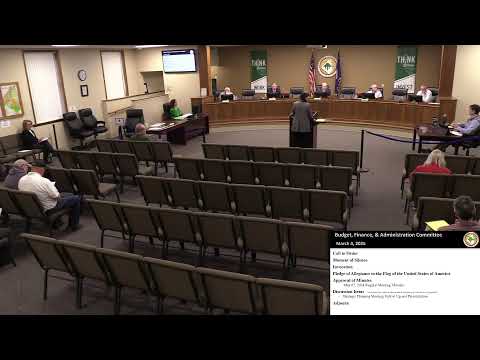
Oconee County committee advances strategic priorities including 2.25% COLA, sewer and quarry investments
Loading...
Summary
At its March 4 meeting the Budget, Finance and Administration Committee reviewed a prioritized list of capital and staff initiatives including a proposed 2.25% cost-of-living adjustment, Exit 4 sewer expansion, quarry capacity investments and measures to address solid-waste capacity and courthouse security.
Oconee County’s Budget, Finance and Administration Committee on March 4 reviewed a staff-drafted strategic-priority list that recommends a mix of near-term, staff-level actions and multi-year capital projects aimed at stabilizing county operations and supporting economic development.
The overview presented by Miss Brock, a county staff member, put an immediate emphasis on a proposed cost-of-living adjustment (COLA) and set out 11 “tier 1” priorities that include sewer and paving projects, quarry capacity, a county paving crew, solid‑waste planning, and Pine Street courthouse security upgrades. Committee members discussed timelines, estimated costs and follow-up steps; staff will renumber and return a draft for committee direction in April.
The proposal’s most concrete near-term item is an implementation proposal for a 2.25% COLA for county staff. Miss Brock told the committee the proposal would align with the State of South Carolina and — if adopted with an effective implementation date of the first pay period in October — is estimated to cost about $565,000. The COLA figure appeared on the staff priority sheet and was identified by the presenter as a funding ask to be considered as the FY26 budget is drafted.
Several infrastructure items were described with preliminary cost estimates and timelines. An Exit 4 sewer expansion to extend a sewer line from the Golden Corner Commerce Park pump station to Exit 4 properties was listed with a design/build cost estimate range of $3.1 million to $3.5 million; staff said bidding would likely take 30–45 days and construction six to eight months depending on supply chain constraints. Miss Brock said the county had recently received a $600,000 deposit from a Rural Development Authority partnership to be applied toward that work once DHEC approvals and an operation-and-maintenance agreement with the Sewer Authority are finalized.
County paving and road maintenance needs were flagged as a near-term two‑year priority: staff recommended creating a county paving crew (in addition to the existing patching crew) and phasing purchases of equipment and training. Miss Brock noted equipment estimates around $2.9 million and suggested spreading hiring and procurement across budget years so training and equipment acquisition do not overburden current road‑maintenance personnel.
Quarry operations were another standing concern. Staff recommended stabilizing stockpiles, increasing equipment-rental budgets to offset a multi‑piece equipment shortfall, and investigating the permitting and cost of adding a second cone crusher and belt line. Miss Brock estimated the equipment cost for a second cone/crusher/belt at roughly $4–5 million and said recurring staffing costs would accompany running two operations; she also described an active land‑acquisition study to secure longer‑term aggregate resources.
Solid‑waste planning and landfill capacity were repeatedly raised by committee members during discussion. Miss Brock told the committee that capital equipment needs for the landfill were estimated at about $3.3 million and that a transfer‑station option sized to roughly 500 tons per day had preliminary cost estimates in the $4.5–$5.0 million range. Staff noted that current permitted operating limits and weekly schedules may require a transfer station in the next three to five years and recommended engaging engineers for site‑selection and due diligence.
Pine Street courthouse security was identified as a priority with several low‑cost, near‑term measures available. Miss Brock said the county could implement additional law enforcement presence during meetings, use hand‑held wand scanners, and limit access through selected doors. She also noted plans to continue the Sheriff’s Office Safety Implementation Plan and suggested adding two additional cameras in the courthouse chamber for documented review.
Other items in the staff list included a county capital improvement plan (an 18–24 month effort to inventory facilities and plan maintenance and growth), removal and digitization of records from the former health department building (staff estimated $25,000 to rent mobile storage for an initial six months), airport tee‑hangar construction (preliminary due‑diligence and grading included in an estimated $4.5 million figure), and Southern Oconee sewer planning contingent on population growth. Miss Brock described the Southern Oconee sewer planning timeline as three to five years and noted a regional average cost figure discussed in the presentation.
Committee members emphasized sequencing and asked staff to prioritize low‑cost, high‑impact items that can be advanced before June 30. Members also requested clearer estimates and budget line references for items that would require capital funding or reallocated millage, and some suggested field reviews (for example, a visit to Pickens County’s landfill operations) to better quantify equipment and processing options.
No formal policy change was adopted at the meeting; staff were directed to renumber the priority list, circulate a revised draft, and present a version for committee review prior to the next council meeting.
Miss Brock and committee members said they expect to continue due diligence and bring back more granular costings and schedules prior to final budget decisions.