
Flagler County weighs options for animal control, tentatively adds shelter to capital list
Get AI-powered insights, summaries, and transcripts
Subscribe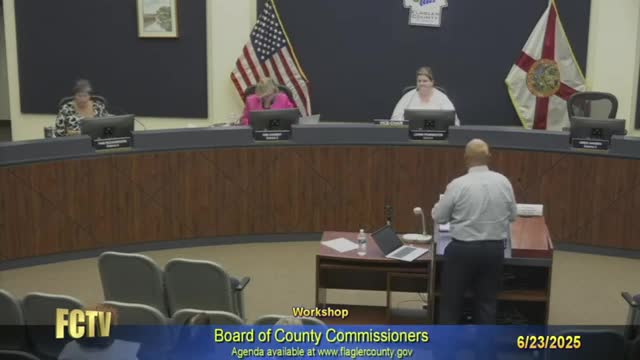
Summary
Flagler County commissioners received a staff presentation on four animal‑control delivery options — including renewing the Flagler Humane Society contract, contracting Palm Coast for domestic animals, operating county services in‑house, or building a municipal shelter — and asked staff to return July 2 with detailed cost and timeline comparisons.
Flagler County commissioners received a staff presentation at a June workshop on four options for animal control services and a conceptual municipal animal shelter, and they asked staff to return with detailed cost comparisons and timelines before making a final decision.
Staff presented four scenarios: a one‑year renewal with the Flagler Humane Society, contracting some services to the City of Palm Coast (domestic animals only), Flagler County operating animal control in‑house, and building a new municipal animal shelter. Miss Petito, the county presenter, said staff carried forward information from a joint April workshop with Palm Coast and had gathered fiscal and operational estimates for each alternative.
The draft one‑year renewal with the Flagler Humane Society would run Oct. 1 through Sept. 30, 2026. Staff anticipated a 3 percent consumer‑price index increase to animal control services — roughly a $6,000 increase on that component — and higher market‑driven increases for shelter services, producing an overall estimated increase “of about 16,000 a year,” Petito said. The shelter and spay/neuter components were discussed as separate charges rolled into the provider billing.
Petito said the spay‑and‑neuter rebate program is budgeted at about $106,000 and covers a $25 rebate per animal; staff estimated that equates to roughly 4,200 rebate‑eligible animals, but she noted the $106,000 figure is a combined line for shelter services and the rebate and may not reflect a precise split between those components.
On operational models, staff presented an apples‑to‑apples cost comparison: the Humane Society option totaled just over $320,000 for animal control plus shelter and spay/neuter; a Palm Coast model providing domestic animal control (with a separate provider for non‑domestic animals) came in at a one‑time start‑up year estimate near $515,000 (that figure includes start‑up capital); and a county‑run model was estimated at roughly $456,000 when shelter and spay/neuter are included.
Petito outlined staffing and capital assumptions for an in‑house program: two animal control officers and one code/permit technician, personnel costs estimated at $187,339, annual operating costs about $57,000, and two vehicles budgeted at $53,000 each. She said some costs are one‑time (vehicle purchases, software acquisition) while others recur (maintenance, insurance, staffing). Petito also noted wildlife and non‑domestic calls currently represent about 8 percent of pick‑ups in the Humane Society data.
Commissioners discussed background checks and board liaison arrangements. Staff recommended level‑2 background checks for animal control officers and level‑1 checks for volunteers; the draft contract language contemplated a one‑time employment screening, and commissioners asked staff to draft contract language requiring annual background checks and to provide copies of those checks to the county. The county also sought clarity on whether a staff liaison or an elected official could attend the Humane Society board’s regular meetings; Humane Society representatives raised concerns that regular board membership could trigger public‑records disclosures for confidential information. Vincent Lyon, a Humane Society board member, proposed monthly liaison briefings and advance distribution of financial and intake reports as an alternative to full board membership.
Staff provided a conceptual shelter design based on other Florida counties: an office building and four kennel buildings providing up to 96 kennels, outdoor covered runs, quarantine and grooming space. Construction plus furniture, fixtures and equipment were estimated at about $2.5 million; site work for an assumed five‑acre site and other contingencies raised the rough total to about $3.8 million. Petito and staff emphasized that the estimate does not include land acquisition and assumed the county or a partner would supply a site if the project proceeds.
Public commenters urged quicker action. Several residents and volunteers described recent increases in animal dumping — with Hargrove repeatedly cited as a problem area — and urged the county to address transparency at the Humane Society, to require annual independent audits, and to prioritize shelter space and staff. Caroline Johnson of Smart Animal Rescue described rescuing a dozen dumped dogs in recent weeks and said local rescues are at capacity. Wendy Tramarci and Anne Thompson pressed for independent audits of the Humane Society and criticized conditions and transparency.
Commissioners did not take a final contract vote. They agreed by consensus to add a municipal animal shelter project to the county’s capital improvements list for planning purposes and directed staff to return to the commission on July 2 with: a year‑two cost projection for the Palm Coast option (to separate start‑up capital from recurring costs); an apples‑to‑apples year‑by‑year comparison of county vs. Palm Coast vs. Humane Society recurring costs (including replacement schedules and inflation/CPI assumptions); a timeline for how long it would take to recruit, train and equip two county animal control officers; recommended contract language on background‑check frequency and reporting of checks to the county; and options for liaison attendance at Humane Society meetings consistent with public‑records law.