
State student advisory board presents recommendations on credentials, counseling and civic readiness
Get AI-powered insights, summaries, and transcripts
Subscribe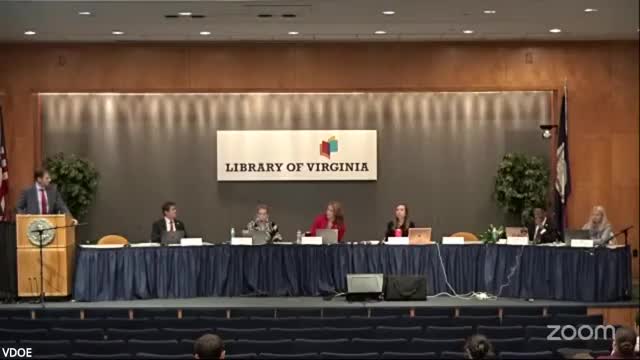
Summary
A student advisory board presented three proposals to the Virginia Board of Education on expanding credential access, improving school counseling services and strengthening civic readiness.
A student advisory board of high‑school representatives presented three policy proposals to the Board of Education during the public meeting: (1) expand access to industry‑recognized credentials (IRCs) by integrating selected credentials into the Uniform Certificate of General Studies (UCGS) passport and aligning high‑school pathways with the Virginia FastForward program; (2) strengthen school counseling by creating a statewide outreach/opportunities database, implementing counselor grade‑cohort continuity and a short student counseling portfolio; and (3) boost civic readiness by improving voting education, adding a political‑misinformation module to digital‑citizenship instruction, and expanding service‑learning and government‑shadowing programs.
On dual‑enrollment and credentials the students argued that removing cost and access barriers would let more graduates leave high school with job‑ready credentials in high‑demand fields such as health care, automotive trades, culinary, HVAC and maintenance. The group proposed using the UCGS passport framework to make selected FastForward credentials transferable or recognized for college credit and to reduce student costs. Presenters cited out‑of‑state models such as Louisiana’s FastForward and Colorado’s programs for precedent.
On counseling the students requested a statewide, searchable database (managed at the superintendent‑region level) of internships, governor‑school openings, summer programs and local opportunities to reduce the workload on building counselors and to give students a “self‑service” starting point. They also proposed a counselor‑continuity model (assigning students to the same counselor for multiple grade years where feasible) and a mandatory short counseling portfolio or Google‑form record that documents internships, work‑based experiences and reflections to speed counselor onboarding and track opportunities.
On civic readiness the students recommended more granular instruction on how to vote (ballot walk‑throughs and polling‑place orientation), a dedicated political‑misinformation module in the digital‑citizenship curriculum, additional community service or service‑learning credit options (they cited Maryland and Delaware models), and expanded access to state‑level simulations such as We the People, YMCA Youth in Government and Project Citizen.
Board members responded positively and asked students to continue working with department staff; Superintendent Gullickson said department and secretariat staff would bring student proposals to interagency meetings and flagged that the ideas will be shared with state education and workforce leads. Students emphasized that many of the proposals are already used by local pilot programs and asked the board to consider statewide scaling or focused pilots.
Speakers and presenters were student advisory board members representing multiple superintendent regions; specific presenters included Clint Wilson (Region 7) and Nicole Bala (Region 8) for the credentials proposal, and other student members for counseling and civic readiness.