Get Full Government Meeting Transcripts, Videos, & Alerts Forever!
Get email alerts on the Port Everglades Budget topic
No spam. Unsubscribe anytime.
Port Everglades leaders present FY‑26 budget, outline $100M reserve for deepening and bond plan
Summary
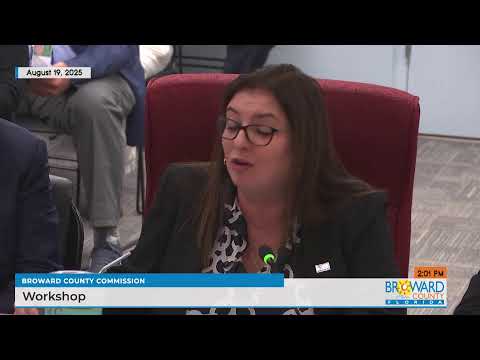
Port Everglades officials presented a recommended FY‑26 operating budget and a multiyear capital plan to the Broward County Board of County Commissioners, asking the board to consider bond financing and outlining a $100 million reserve for the port’s deepening and widening project.
Port Everglades officials presented a recommended FY‑26 budget to the Broward County Board of County Commissioners and outlined a multi‑year capital program that includes a $100 million reserve for the port’s deepening and widening project.
The presentation, delivered by Joe Morris, director of Port Everglades, emphasized recent throughput gains: "we had our record breaking cruise throughput in terms of passenger activity," Morris said, and noted more than 1,100,000 TEUs of container cargo in calendar 2024 and a strong energy throughput year. Morris said the port’s updated economic impact study showed fiscal‑year 2024 economic impact rising from about $26.5 billion to $28.1 billion and local jobs up about 13.9 percent.
Morris described a recommended FY‑26 operating budget that increases top‑line revenue by roughly $12 million (about 5.5 percent) compared with the prior year and a proposed $6 million increase in operating expenses. He noted the port’s "big three" business lines—cruise, cargo and energy—account for roughly 80 percent of revenues and will remain the primary drivers.
Port staff said most line items are above forecast while a smaller, cyclical category called "lay‑in" is projected to decline about 33 percent from a high FY‑24 level. Glenn (deputy director) explained that lay‑in covers unpredictable stays such as military or commercial vessels requiring extended berth time and that the drop largely reflects a reversion from an above‑typical FY‑24.
On the expense side, the staff highlighted a 23 percent increase in utility costs tied in part to higher Florida Power & Light rates and tenant usage. Maintenance and repair is proposed to fall slightly from about $15.6 million to $14.9 million; staff described that as belt‑tightening after larger projects in prior years.
The port’s capital improvement program drew most of the scrutiny. Morris and his team described ongoing bulkhead replacement work, continued momentum on the deepening and widening project and a portfolio of port projects including slip‑1 expansion and cruise terminal investments. "We have tremendous momentum on our deepening and widening project," Morris said, and added the team expects "the next major milestone in November." The port is also budgeting for ongoing cruise terminal upgrades and a consolidated maintenance facility to replace several dispersed maintenance sites.
Morris said the proposed CIP includes funds to advance shore‑power duct bank design, and acknowledged adjustments to sequencing in response to cruise line scheduling. For the slip‑1 expansion, staff said the work will remove about 150 feet of dock to enable larger berths and that work will extend over multiple years.
On financing, the port said an anticipated bond issuance will be on the commission’s Thursday agenda. Staff recommended Jefferies as senior manager with Ramirez and Wells Fargo as co‑managers for the underwriting team. The port indicated the issuance is expected to be about $130 million, with a not‑to‑exceed figure discussed at $140 million, and said the bond program would help fund projects such as bulkhead replacement and portions of the CIP.
Public‑safety costs at the port also drew questions. Glenn told commissioners the Broward Sheriff’s Office submitted large budget requests—about a 20.4 percent increase for law enforcement and a 38.3 percent increase for fire rescue—driven in part by overtime. "We used [the county administrator’s] 3 percent as our starting point and then looked for deltas," Glenn said; port staff said they adjusted sheriff line items for specific, port‑driven needs such as increased cruise ship calls and liquefied natural gas training for fire rescue.
Commissioners pressed port staff on parking capacity and on reuse of airport or off‑site parking. Port staff said the port is studying vertical parking and a garage adjacent to Terminal 29 as part of terminal redevelopment and also considering a centrally sited garage independent of any single berth. Staff stressed that peak days—large ships and short itineraries—drive high demand for port and employee parking.
On environmental and regional coordination, port staff reported ongoing work with the Army Corps, federal delegation support, and related permitting. Staff said they are setting aside funds for the deepening and widening project and working with congressional and federal partners on appropriations and permitting.
The commission did not take a formal vote during the presentation; staff said several items—bond authorization on Thursday, final procurement and contracting steps—will return to the board for committee or public‑meeting approvals. Port staff said they will provide further details on bond structure, project phasing and law‑enforcement budget negotiations as they become available.
What’s next: the commission will consider the recommended underwriting team and bond authorization on its Thursday agenda; port staff will return with refined financing details and follow‑up on law enforcement discussions and CIP phasing.