
Broward County outlines homeless-services expansion, warns law could change outreach tactics
Get AI-powered insights, summaries, and transcripts
Subscribe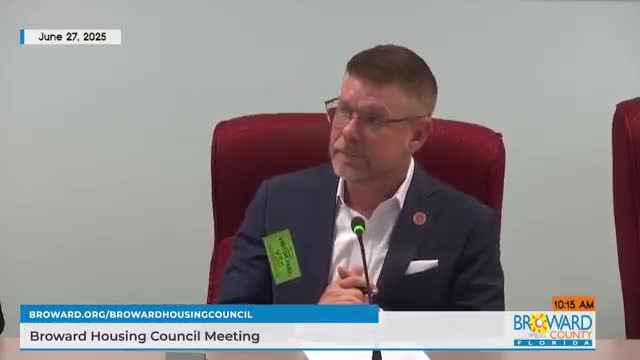
Summary
Patrice Baldino, director of Broward County’s Housing Options, Solutions and Supports Division, told the Broward Housing Council that county outreach teams contacted 5,129 people in the second quarter and that county leaders are piloting motel conversions, shared‑living and landlord incentives while adapting operations to comply with House Bill 1365.
Patrice Baldino, director of Broward County’s Housing Options, Solutions and Supports Division, told the Broward Housing Council that the county is expanding outreach and experimenting with alternative housing models while monitoring the effects of a 2024 state law on how municipalities must respond to people sleeping on public property.
Baldino described the county’s role as the Continuum of Care collaborative applicant for U.S. Department of Housing and Urban Development funds, summarized service and shelter capacity, and presented second‑quarter outreach data and recent pilot programs. She also outlined steps the county is taking to respond to House Bill 1365, enacted October 2024.
Baldino said the county’s street outreach teams met 5,129 individuals in the second quarter, representing 3,500 households, and that 996 people met the county’s definition of chronically homeless. She noted the county owns the North and Central Homeless Assistance Centers — together listed at 587 beds — and recently re‑contracted with a provider to add capacity at the Broward Outreach Center in Hollywood.
“We are the section…that manages all of the programs for the homeless across the county,” Baldino said, describing HOSD’s role in distributing federal, state and local funds and subcontracting with nonprofit providers for services including housing navigation, rapid re‑housing and case management.
Baldino reviewed several alternatives the county is piloting to reduce shelter pressure. She described a motel conversion run by the AIDS Healthcare Foundation called the Villages at New River (the former Days Inn on Broward Boulevard), which has about 140 units. Broward County placed 17 families there and paid deposits and rent from January through June 30, she said; residents were selected on the basis of having monthly income about $1,500. The county also supports shared‑living programs that lease individual bedrooms in four‑bed houses; Baldino said roughly 16 people are in shared living placements and many are older than 55.
Baldino contrasted program costs: sheltering a single person costs about $16,000 per year, she said, while keeping a family of four in shelter approaches $64,000 per year. She urged the council to weigh whether targeted gap subsidies or alternative placements are a better use of funds than long‑term sheltering.
Baldino summarized the county’s budgets for homelessness work as presented: general funds in excess of $26,000,000 and grant funding of about $18,000,000, for a total near $45,000,000 for HOSD services; she said the Family Success Administration Division (prevention side) had additional funding (presented as approximately $68,000,000 for prevention services). She did not provide contract‑level line‑item detail during the presentation.
On landlord engagement, Baldino described a landlord initiative that offers first, last and security deposits and occasional landlord incentives to encourage owners to rent to people with barriers such as recent evictions. The county plans a November event to recognize participating landlords and recruit additional partners to reduce the time staff must scramble to match tenants to units.
Baldino addressed counting challenges and House Bill 1365’s effects on outreach and reporting. She said HUD’s point‑in‑time count is imperfect and that HB 1365 “may have had a chilling effect” on voluntary participation in counts. She described HB 1365 as requiring jurisdictions to attempt to cure written complaints about camping/sleeping on public property within five days and noted county staff are using QAlert to log complaints and coordinate responses; she said the county is planning to expand adult civil citation and community court diversion as part of the response.
Baldino emphasized the county’s preference for housing‑first, supportive approaches and said the law does not itself make sleeping on public property a new crime but creates a civil complaint mechanism that could lead to injunctions. She said, to date, she was not aware of statewide lawsuits filed under the statute and that the county’s approach has focused on engagement before enforcement.
Council members asked for additional breakdowns Baldino said the county collects (for example, behavioral‑health subcategories within the behavioral‑health flag) and asked about zoning and shelter expansion. Baldino said Fort Lauderdale is working to change an ordinance so the Central Homeless Assistance Center (the “Central HACC”) can expand from roughly 260 beds to about 300, which would add roughly 40 beds.
Baldino closed by asking for council input and offering to share the presentation slides and data with members.
The council later voted to appoint Housing Council member Tanisha Taylor to serve on the Broward Continuum of Care board; the motion was moved and seconded and approved on voice vote (details of individual yes/no votes were not specified in the meeting transcript).