Get Full Government Meeting Transcripts, Videos, & Alerts Forever!
Get email alerts on the City Budget topic
No spam. Unsubscribe anytime.
DeKalb council reviews FY2026 budget as police-and-fire pension shortfall looms
Summary
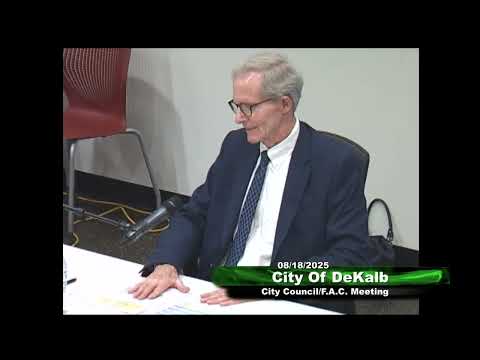
DeKalb City Council and the Financial Advisory Committee on Aug. 18 heard a preliminary review of the proposed fiscal 2026 operating budget that highlighted a large police-and-fire pension liability and revenue uncertainties that could affect future levies and reserves.
DeKalb City Council and the Financial Advisory Committee on Aug. 18 heard a preliminary review of the proposed fiscal 2026 operating budget that highlighted a large police-and-fire pension liability and revenue uncertainties that could affect future levies and reserves.
City Manager Nicholas opened the presentation, saying, "I have provided you with some background information on a preliminary point in our budget process. It's a very public process." He told council members the city is early in the budget calendar and expects more detailed work in October and again in November and December.
The presentation to elected officials and advisory commissioners emphasized that personnel costs account for roughly 85% of projected expenditures and that roughly 75% of general fund revenue comes from a handful of sources: property tax, state and home-rule sales taxes, municipal utility tax and investment interest. Nicholas said the city is working from state-reported revenue numbers that lag by several months and that estimates will be refined as firmer data arrive.
Why it matters: the city’s actuarial reports show an unfunded liability tied to the police-and-fire pension system totaling about $104 million, and the plan must reach a 90% funded level by 2040 under the current actuarial schedule discussed in the meeting. Nicholas warned that the most recent projection for 2026 shows a funding shortfall for the city of about $1.9 million, an amount the city has been covering from reserves to avoid increasing a levy that would raise property tax rates for residents.
Alderman Smith summarized the stakes in blunt terms during the discussion: "I get to take the keys to city hall, down to Springfield, hand them to the governor, and say, I guess the city is yours now, because we're bankrupt," he said, rhetorically criticizing the lack of a state-level solution and urging attention to the funding problem. Nicholas and others said a legislative remedy would be necessary to change the long-term actuarial approach and that statewide organizations — including firefighters’ and police unions and the Illinois Municipal League — are potential allies for legislative changes.
Nicholas and Finance Director Susan Harmon (who Nicholas said is leading budget preparation with Senior Accountant Megan Challen) walked through revenue drivers and recent one-time and recurring developments. Nicholas noted the local impact of large data-center development, saying Meta generated $46,344,347 in property taxes distributed among the city’s 10 taxing bodies over the past three years, with about $31 million in 2024 alone going into local levies and distributed across taxing districts.
Nicholas said the city has reduced its own portion of the property tax rate substantially over the last five years — from about $1.24 per $100 of EAV to about $0.62 — but that the overall property tax bill is driven primarily by other taxing bodies, notably the school district. He told the council the city has been using reserve funds to smooth the pension shortfall rather than raising levies.
The presentation also described a balanced operating budget scenario for FY2026 with a modest projected net reserve increase under the assumptions shown, but Nicholas warned that the projections are sensitive to state revenue remittances, EAV determinations, appeals and other variables that will be clearer in the fall.
No formal fiscal actions were taken at the meeting. City officials and advisory commissioners agreed to continue work on the budget and to return with more detailed line-item information and options in October and again as the levy discussion approaches in late fall.