Get Full Government Meeting Transcripts, Videos, & Alerts Forever!
Get email alerts on the Water Quality topic
No spam. Unsubscribe anytime.
City reports improved lake levels, outlines algae-monitoring steps and temporary treatment costs
Summary
City staff briefed the council on lake levels, microcystin and MIB monitoring, use of powdered activated carbon this spring, and plans for a permanent PAC system and granular-activated carbon changeouts.
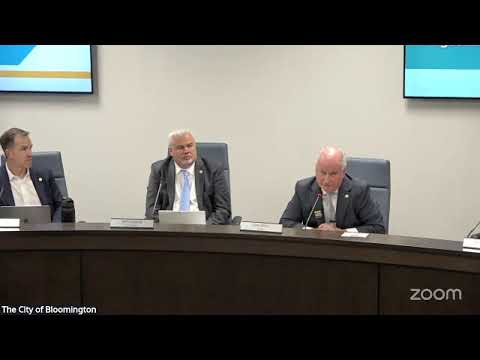
The Bloomington City Council received an update Aug. 25 on the city's drinking-water sources and treatment actions as staff outlined monitoring results for taste-and-odor compounds and the harmful-algae indicator microcystin. City staff said Lake Bloomington and Lake Evergreen have largely rebounded from last year's deficits and that staff are preparing treatment and monitoring plans for the coming seasons. "Lake Evergreen is just slightly down by 0.23 feet and Lake Bloomington is 0.87 feet," a city water director told the council.
The director said the city uses 10 nanograms per liter (ng/L) as a practical threshold for finished-water taste-and-odor complaints and that raw-water concentrations can be much higher. Lake Evergreen raw MIB (an odorous compound) recently measured about 270 ng/L; the director said with current treatment options the plant can remove roughly 98% and maintain finished-water levels below the taste-and-odor threshold under many scenarios. "We have achieved up to 98% removal efficiency," the water director said, describing jar testing and split-sample verification with their commercial lab, Eurofins, and with the Illinois Environmental Protection Agency.
City staff said they used about 174,000 pounds of powdered activated carbon (PAC) from March through June at a reported price of about $1.37 per pound, and that those purchases cost roughly a quarter of a million dollars in the spring event. The city is fabricating a permanent PAC silo and expects to issue a bid package for foundation and plumbing work with a targeted installation in late December or early January. Staff also said recent granular activated carbon (GAC) changeouts increased treatment capacity and that additional GAC replacements are planned this fall.
Staff described weekly and monthly sampling that will continue in coordination with the Illinois EPA and the Department of Natural Resources, and said hydrosphere buoys measure temperature, dissolved oxygen and pH at near-surface depths for each lake. "We're doing weekly monitoring both with Eurofins and in-house," the director said. City staff said an optional second round of lake treatment for Lake Evergreen is held in reserve, with consultation from aquatic-controls contractors and IDNR, and that staff are timing treatments to gain maximum effect as temperatures cool.
The council asked several technical questions. Council member Mosley asked why Lake Evergreen's raw MIB numbers were higher; staff said raw-water spikes are expected and that the combination of PAC plus GAC and blending strategies is the toolset available to lower finished-water levels. The water director said jar testing this week will help staff identify PAC dose options to blend raw water from the two lakes without exceeding the finished-water threshold.
Why it matters: Algal toxins and taste-and-odor compounds can degrade drinking-water palatability and, at higher concentrations, create health advisories. City staff described monitoring and treatment steps intended to protect finished water while limiting unnecessary chemical use and cost.
What happens next: Staff will continue weekly sampling, finalize jar-test results, complete PAC-silo fabrication and present updated treatment plans if raw-water conditions change. No ordinance or budget change specific to water treatment was approved at the meeting; staff noted prior council-authorized permits and treatment allocations remain available.