Get Full Government Meeting Transcripts, Videos, & Alerts Forever!
Get email alerts on the Surplus Property And Housing topic
No spam. Unsubscribe anytime.
Alamogordo commissioners discuss auctioning city-owned lots, options for affordable housing
Summary
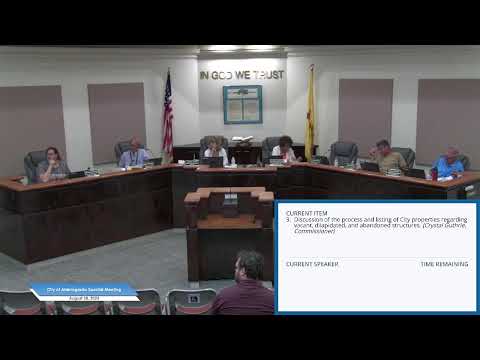
Alamogordo City Commission members and staff discussed how to dispose of vacant city-owned parcels and whether the city can use those lots for housing or community projects, with staff saying foreclosed properties must be sold per state law and officials aiming to present an auction plan to the commission within weeks.
Alamogordo City Commission members and staff discussed how to dispose of vacant city-owned parcels and whether the city can use those lots for housing or community projects, with staff saying foreclosed properties must be sold per state law and officials aiming to present an auction plan to the commission within weeks.
The discussion matters because the disposition of small, infill parcels affects the city’s ability to encourage housing development, support nonprofit projects and reduce blight on narrow lots where private builders have said profit margins are low. City staff said they will research legal steps and return to an open meeting with options for selling or otherwise using the properties.
City staff described two legal classes of property at issue. Parcels the city acquired through foreclosure must be sold “on the courthouse steps,” staff said, citing state statute; land the city acquired by other means — for example by donation or through collateral for a special assessment district — can be retained and may be transferred under different terms, including memoranda of understanding with nonprofits. A staff member told commissioners, “we can absolutely do something like that” for non-foreclosed parcels, but added that foreclosed properties “we have to sell it per state statute.”
Commissioners and staff discussed practical limits that affect whether a parcel is attractive to builders: many of the city lots are narrow (about 30 to 40 feet wide) and deep (100 to 150 feet), and typical houses for those lots would likely be roughly 1,200–1,500 square feet. Staff and commissioners noted that builder profit margins for individual lots of that size are small unless a developer builds many units at once, and that meter placement, setbacks, property-line issues and surveying add cost and complexity. One commissioner summarized the builder view: small, single-lot projects are rarely profitable unless bundled.
To make the lots more marketable, participants suggested a set of policy options: clearing and leveling lots (possibly adding fill to reach base flood elevation), selling lots in grouped blocks to make projects profitable, rezoning or reducing setbacks where safe to do so, and engaging nonprofit partners. City staff cited Dudley, where the city keeps property while entering MOUs for community gardens, as a model for non-foreclosed property uses.
Commissioners raised housing partnerships as one path. A local developer, Tommy Harrell, has proposed a project called Valor Point Village focused on homeless veterans; staff said Harrell is forming a 501(c)(3) to qualify for certain assistance and that any donation or below-market transfer of city land would require terms such as reversion to the city if the project does not proceed. Staff said only one feasible private developer plan had been presented so far and that nonprofit partners such as Habitat for Humanity could also be options, but that nonprofit projects often take longer to complete.
On finances and building options, participants discussed relative costs: modular homes were cited at roughly $175,000 in the meeting as a current price example, while speakers described older “drag-in” mobile setups at lower advertised prices; attendees also noted the additional costs of foundations and utility connections. Staff emphasized that the city does not have unilateral authority to waive state-mandated sale procedures for foreclosed parcels.
On funding and gifts, staff advised caution about accepting restricted donations. Staff noted that the Sacramento Foundation is not a 501(c)(3) and therefore can engage in lobbying; staff said the city can accept community-focused funds without strings attached, but it cannot accept a donation intended for a single private beneficiary because that would raise legal problems. As staff put it, “a donation has to have no strings attached, basically.”
Staff said it will publish legal notices and finish research on title and lien questions and then return to the commission with specific sale options, including whether to sell parcels as individual lots or in grouped blocks and whether to set minimum bids or retain liens that require buyers to renovate. A city staff member told commissioners they hoped to move quickly: “I want to do it as soon as possible,” and the staff member said they would seek to present sale options intended to be in place by November.
Direction and next steps recorded in the meeting included staff researching legal requirements and auction mechanics and preparing an open meeting with a proposed list of properties and recommended disposition methods. The meeting closed after a motion to adjourn was made and seconded.
The discussion touched on multiple neighborhoods (including the Dudley area, Walker area and Gray Street) and on the need to survey some city parcels where property lines cross parking and other infrastructure. Commissioners flagged that even when code enforcement issues are pursued, outcomes can depend on the courts, which may defer or dismiss tickets; staff highlighted that the city’s enforcement actions sometimes do not appear visible to residents because of subsequent judicial decisions.
No formal sale or donation was approved at the meeting; staff will return with legal research and a recommended process for selling or otherwise transferring city-owned parcels.