Get Full Government Meeting Transcripts, Videos, & Alerts Forever!
Get email alerts on the Code Enforcement topic
No spam. Unsubscribe anytime.
City staff outlines process for dealing with vacant lots, dilapidated structures; 51 lots and 121 structures under review
Summary
Code enforcement described a multi‑step process that can lead to demolition, liens and foreclosure. Staff said they are researching 51 potentially city‑owned lots and have identified about 121 dilapidated structures in various stages of enforcement.
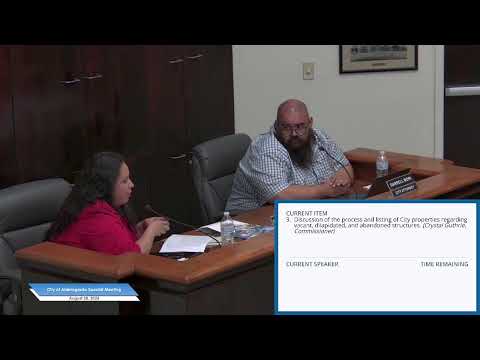
City Code Enforcement Manager Josh Sides and city staff briefed the commission Aug. 28 on the city’s process for addressing vacant lots, dilapidated and abandoned structures and on the current inventory of potential city properties.
Sides described the multi‑step process: identification, certified notice requesting consent to inspect, a consented or warrant‑based inspection, a detailed notice of violations with corrective steps, a period to contact code enforcement with a repair plan or to complete repairs, and, if necessary, a commission resolution to condemn a structure. “If you do not contact me after the 30 days and you didn't correct the violations, I bring a resolution for condemnation to the commission,” Sides said.
The condemned property owner then has statutorily prescribed timelines: by state law, owners are required to commence demolition within a specified interval after a condemnation resolution; accounts receivable then invoices demolition costs back to the property owner, and unresolved invoices can lead to a lien and foreclosure. The city explained a one‑year redemption period after foreclosure; until that period expires the property may not be fully under city title.
Staff said they are researching 51 lots that may be city‑owned depending on foreclosure status and identified roughly 121 dilapidated structures in various enforcement stages. In recent months staff said they had moved more quickly in several cases and hired contractors to demolish multiple properties; code enforcement said six demolitions were contracted recently with more pending, and the working total of structures scheduled or completed was discussed as nine in aggregate.
Sides said the department prioritizes the most dangerous structures (rank‑3), including structure‑fire damage and imminent structural collapse, with rank‑2 and rank‑1 properties addressed as capacity allows. He described the department’s volume: about 1,493 cases processed so far this calendar year and a typical yearly caseload of roughly 2,500 cases across four field officers in addition to Sides.
Commissioners asked whether the city can rehabilitate structures instead of demolishing them. City staff said rehabilitation programs exist at the state level for eligible homeowners, but the city does not routinely fund large‑scale rehabilitation of privately owned dilapidated structures; if the city acquires clear title via foreclosure it could pursue alternate reuse strategies including selling grouped lots as a single parcel for infill development. Staff noted flood‑plain and base flood elevation requirements can make backfilling and redevelopment costly in some neighborhoods.
Why it matters: The inventory and process determine whether vacant lots are demolished and later sold at auction, left vacant, or consolidated for redevelopment. The timeline from enforcement action to clear city title can be multiple years and includes legal steps, invoices and a redemption period.
What’s next: Staff will complete research on the 51 lots, present a consolidated list to commissioners and prepare options for sale, bundling or other disposition once legal title clears.