Get Full Government Meeting Transcripts, Videos, & Alerts Forever!
Get email alerts on the Housing Policy topic
No spam. Unsubscribe anytime.
Commission discusses housing strategy, Patriot Point proposal and metropolitan redevelopment areas
Summary
The commission debated whether to use Metropolitan Redevelopment Area (MRA) tools and property tax abatements to incentivize housing development at Patriot Point and elsewhere. City and county attorneys warned of legal proof requirements and possible challenges; staff will prepare comparative materials and a resolution for the next meeting.
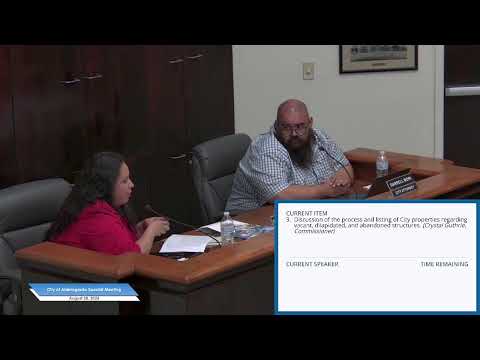
The Alamogordo City Commission spent the bulk of its Aug. 28 special meeting discussing housing initiatives, legal tools to incentivize development and a proposal for the Patriot Point apartment site.
Commissioners and staff focused on whether designating targeted tracts as a metropolitan redevelopment area (MRA) — commonly called declaring an area “blighted” under state law — would create tax incentives, state funding access and other benefits that could make private development viable.
Daryl (city attorney) explained the MRA process, saying the statutory definition of a blighted area is broad but that smaller, narrowly drawn areas are harder to defend in court. “The smaller the area, the city has to have proof and be able to design and show how the area is blighted,” Daryl said. He cautioned that a designation can be challenged and reversed if the city cannot substantiate the claim.
Otero County attorney RB Nichols described the county’s recent resolution of intent and summarized projected tax‑revenue figures that have been discussed in county briefings. In the meeting he said, “currently, it's around 18,000. Once it's developed based on the current, valuation of the development, it would be around a $100,120,000 a year. So over the course of 7 years, we're talking $7,800,000.” (Transcript figures were imprecise; staff and the county flagged the need to reconcile valuation and tax‑revenue estimates.)
Several commissioners expressed mixed views. Mayor Pro Tem Sharon McDonald urged a comprehensive housing strategy and raised concerns about concentrating low‑income housing in certain districts. Commissioner Warren Robinson and others urged the city to be proactive and to consider multiple tools, including MRAs, a retooled GRIP program (a prior local incentive that was repealed), the city’s existing affordable‑housing ordinance and development‑review reforms.
A staff presentation noted the city already has a downtown Metropolitan Redevelopment Area plan adopted in 2019 and asked whether that plan could be updated or expanded. Some commissioners asked staff to gather maps and photographs from cities that have used MRAs — Las Cruces, Albuquerque, Los Alamos and Gallup were cited — so commissioners could compare evidence used to justify blight designations.
Commissioners agreed to ask staff to prepare additional research and to add a resolution related to Patriot Point to a future meeting agenda so the city may record its intent and provide information needed by the developer for financing timetables. Staff and consultants present indicated that Patriot Point financing discussions would benefit from a municipal resolution of intent by mid‑October if the developer is to meet certain lender deadlines; staff said they will prepare materials and legal analysis for the commission.
Why it matters: The choice to use an MRA and property‑tax abatements affects whether private developers can close financing for large apartment projects and whether the city and county temporarily forgo some tax revenues in exchange for new construction and long‑term tax base growth.
What’s next: Staff will gather examples of redevelopment areas from peer cities, clarify tax‑revenue estimates with the county assessor’s office and present a proposed resolution and recommendations at a future meeting. No final vote on a redevelopment designation or tax abatement was taken on Aug. 28.