
Urbana council adopts Imagine Urbana comprehensive plan after amendment narrowing protections for select historic neighborhoods
Get AI-powered insights, summaries, and transcripts
Subscribe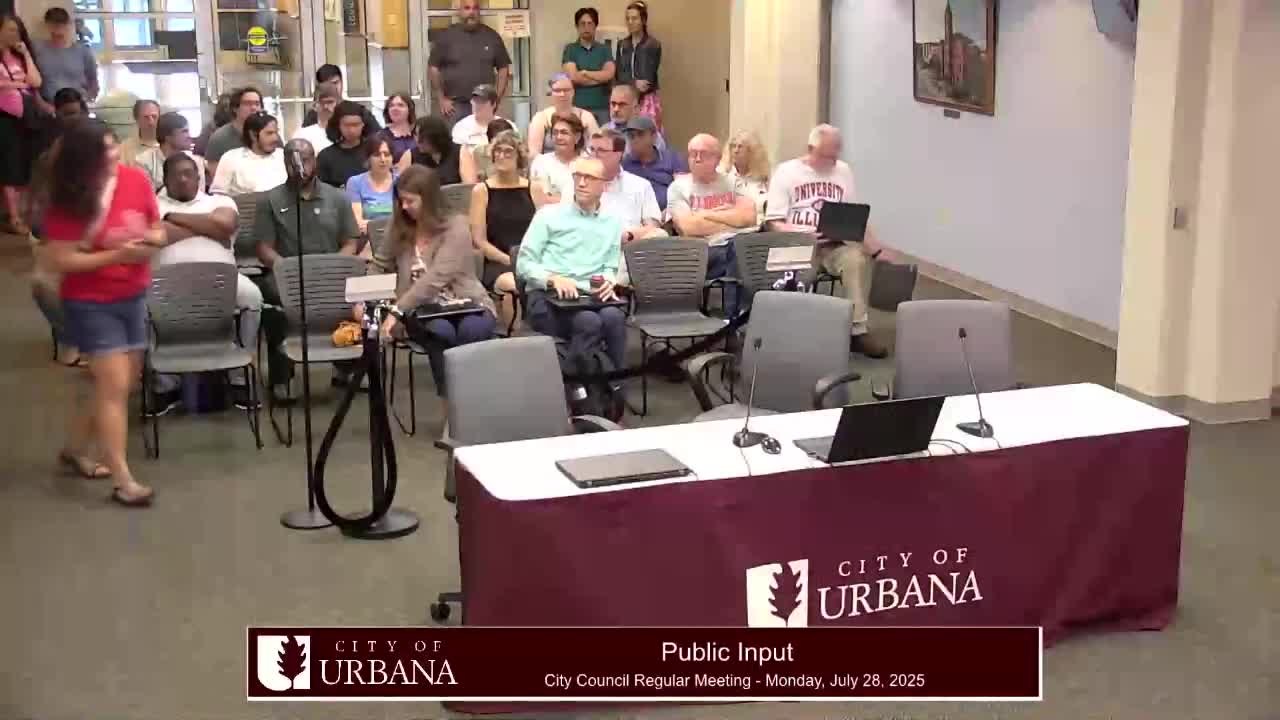
Summary
The Urbana City Council voted July 28 to adopt Imagine Urbana, the city’s 20‑year comprehensive plan, approving an amendment that narrows proposed citywide preservation of single‑family and duplex zoning to three named historic neighborhoods.
The Urbana City Council voted July 28 to adopt Imagine Urbana, the city’s proposed 20‑year comprehensive plan, approving the ordinance after a council amendment that narrowed a proposed citywide preservation clause to three named historic neighborhoods. The ordinance passed on a unanimous roll call after earlier votes on amendment language split the council.
Council members and dozens of residents debated the plan for more than two hours, with public commenters sharply divided. Proponents said the plan supplies a needed framework to guide housing, transit and walkability as university enrollment and development pressures rise. Opponents said the plan would accelerate conversion of single‑family homes into rentals and urged more neighborhood‑level study before adoption.
The vote followed an amendment from Council member Mary Alice Wu that originally would have inserted language to “preserve existing single unit or duplex zoning where it currently exists” across N1 neighborhoods and to remove permission for small businesses on corner lots; after discussion she narrowed that preservation language to apply only to West Urbana, the Dr. Ellis subdivision and historic East Urbana. The amendment passed on the roll call (Council member Wu: yes; Evans: yes; Hersey: yes; Colasetti: no; Bishop: no; Wilkin: no; Quisenberry: yes). Thereafter the main ordinance (Ordinance No. 2025‑04‑013) was approved unanimously (all council members recorded “yes”).
Why it matters: City leaders said the plan is intended to be advisory and to start a process — including a promised housing study — that will inform later zoning and neighborhood plans. Supporters argued the city needs a strategy to address rising housing demand tied to the University of Illinois and to support walkability and small businesses. Critics said the plan lacks the neighborhood‑level data needed to protect long‑term homeowners and to measure effects on affordability.
Supporters at the meeting included members of Curbanism Club and the Urbana Bicycle Pedestrian Advisory Commission, who urged adoption to accelerate housing choices and safer streets. “Imagine Urbana directs the city to complete a comprehensive housing study, which would actually tell us our true housing needs,” said Adani of Curbanism Club during public input. BPAC vice chair Annie Adams urged the council to adopt safe‑systems street design in tandem with housing changes.
Opponents focused on West Urbana and similar neighborhoods. Several neighborhood speakers, including members of WUNA (West Urbana Neighborhood Association) and long‑time homeowners, urged postponement until a detailed housing study and neighborhood maps were produced. Michael Plava, a WUNA member, said residents had repeatedly asked for maps and data and felt ignored by planning staff and the commission.
Council discussion emphasized the plan’s advisory status: multiple council members said they would not support immediate, sweeping zoning changes without additional studies. Council member Grace Evans said she would “personally commit to not having any major zoning changes until we have the housing study and some more information.” Council member Jaya Hersey urged the council to consider students and other groups as long‑term community members and to plan for keeping them in Urbana.
Next steps: Council members said the plan will trigger more detailed neighborhood plans and a citywide housing study. Several council members and staff pledged that items requiring zoning changes would return to council for separate deliberation and ordinance votes; staff also committed to assemble the requested data and neighborhood maps.
A full accounting of the public comments, the amendment text, and the housing study scope were not finalized at the meeting; the council directed staff to produce those materials for future sessions.