
Urbana council debates rule changes: voting order, chair role, abstentions, agenda placement and meeting-time limits
Get AI-powered insights, summaries, and transcripts
Subscribe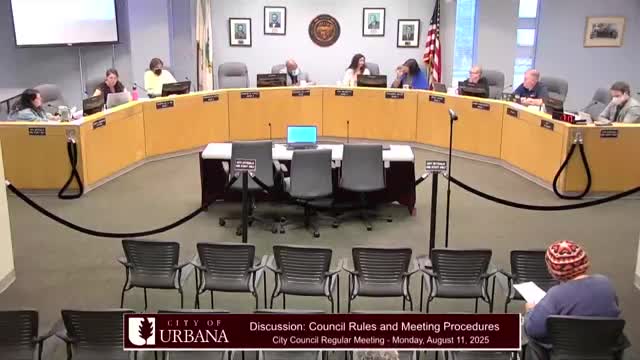
Summary
The Urbana City Council spent most of its Aug. 11 meeting reviewing and debating possible amendments to its council rules — including rotating the voting order, gender-neutral language, whether the chair can relinquish the chair to enter debate or make motions, how abstentions and "present" votes are recorded, agenda-placement rules and council-member time limits — but took no formal votes to change the rules that night.
Urbana City Council devoted a lengthy portion of its Aug. 11 meeting to discussing possible amendments to its council rules and meeting procedures, a rules package the clerk said has not been modified since January 2021. The council discussed several discrete topics — rotating voting order, gender-neutral language and how council members are addressed, the chair—s ability to participate in debate, clarifying abstentions and conflicts of interest, how items are placed on agendas, and whether council-member communications should match the five-minute public input time — but took no formal ordinance or resolution votes to change the rules that night.
Why it matters: council rules determine how meetings are run, how members participate and how business reaches the agenda. Changes could affect day-to-day council workflow, the order of voting, how conflicts and abstentions are recorded, and the ability of individual council members to bring items to meetings.
Discussion highlights and outcomes
- Voting-order rotation: council discussed a proposal (suggested by Council member Quisenberry) that the chair vote last, with the roll rotating predictably from the left of the chair and repeating the same order for subsequent meetings. Clerk and several council members described options for special meetings. A straw poll indicated support for a predictable numerical rotation starting to the left of the chair and having the chair vote last for the sequence of meetings discussed; no formal rule change was adopted that night.
- Gender-neutral language and forms of address: council members generally favored replacing honorifics such as "Mr." or "Ms." with gender-neutral forms ("council member," "trustee" or preferred names) in minutes and roll call; several members said the minutes already use "trustee" or "council member," but they asked the clerk to standardize that language in the rules.
- Chair participation in debate and motions: discussion clarified an existing practice and a proposed rule edit: the chair may relinquish the chair to participate in debate or make a motion but must formally cede the chair before entering debate or making a motion. Council members asked for explicit wording to remove ambiguity and avoid situations where chairing inhibits participation.
- Abstentions, conflicts of interest and votes of "present": clerk and legal staff noted that city code and state law govern when members must abstain for conflicts of interest; council discussed whether members should be asked to state the nature of a conflict briefly for the public record. The clerk clarified that recorded votes on ordinances/resolutions capture yes, no and abstain fields; separately a "present" vote is recorded with the prevailing side in the tally under current practice. Council members asked for an explanatory chart showing how abstentions and presence votes affect majorities for different types of votes because state law uses both "members present" and "members total" in different places.
- Agenda placement and special meetings: council members debated whether a single council member should be able to place items on the Committee of the Whole agenda and whether two or three members should be required to place items directly on the City Council agenda. Opinions divided: some members favored allowing single-member placement for Committee of the Whole discussion, while others argued that final-action items should usually start in committee and that extraordinary or time-sensitive items might warrant exceptions. The clerk and city attorney reminded the council that municipal code allows three members or the mayor to call a special meeting; legal counsel also cautioned about Open Meetings Act (OMA) constraints when multiple members communicate outside a public meeting.
- Council input time limits: council took a straw poll to keep council-member communications at three minutes (matching an existing limit). The clerk noted council members may request additional time by the usual procedural mechanisms.
Staff direction and next steps: the clerk said staff would draft a red-line version of the existing council-rules resolution showing the suggested edits and bring it back for further Committee of the Whole discussion. Council members and the city attorney suggested compiling disparate rules and past resolutions into a single, codified set of rules for clarity and public accessibility.
No formal amendments were adopted at the Aug. 11 meeting; multiple straw polls were used to gauge support and the clerk will return with a draft resolution and highlighted proposed changes for future consideration.