
Urbana council approves liquor license, multiple housing-and-homelessness subrecipient agreements and alternative response spending
Get AI-powered insights, summaries, and transcripts
Subscribe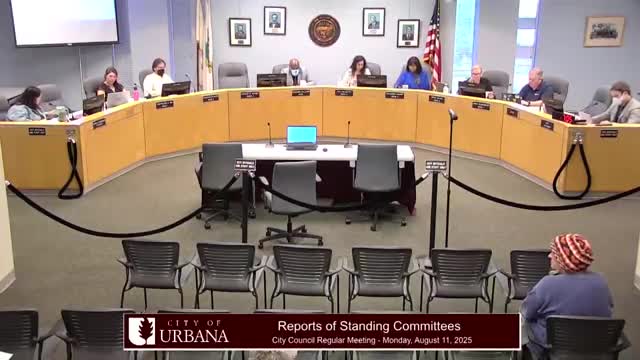
Summary
At its Aug. 11 meeting, the Urbana City Council approved a consent agenda that included an increase in liquor licenses for a downtown restaurant and a series of subrecipient agreements using Housing and Homeless Innovations (HHI) funds, plus authorization of alternative response task force expenditures.
Urbana City Council on Monday approved its consent agenda, including an increase in Class R and T-1 liquor licenses for Cephalus LLC and a set of subrecipient agreements using Housing and Homeless Innovations funds for local homelessness and shelter services. The council also authorized expenditure of alternative response task force funds.
The council voted unanimously to approve items A through J on the consent agenda after Committee of the Whole presentation and a single motion and second. Committee of the Whole chair Council member Bishop presented the items, which included resolutions to authorize HHI subrecipient agreements and a liquor-license increase. Clerk called the roll and recorded affirmative votes from the seated council.
Why it matters: the package allocates city-managed HHI grant dollars to several local providers and authorizes funds for alternative response work, directing money to emergency shelter, family services and operating support for local homelessness providers.
Most important facts: the council read and approved a sequence of resolutions that the Committee of the Whole forwarded. The resolutions listed on the record include the liquor-license increase for Cephalus LLC at 510 North Cunningham Avenue and a set of HHI subrecipient agreements for local organizations and townships. The council also approved a resolution authorizing expenditure of alternative response task force funds.
Details presented to the council identified the recipients by resolution number and name as read into the record. The reading included agreements between the city and the following entities for HHI funding: Champaign County Health Care Consumers for special populations outreach and enrollment; Champaign County Regional Planning Commission for emergency family shelter; Champaign Township for Scribe Shelter; Cunningham Township supervisor’s office for care/bridge-to-home program; CU at Home Inc. for Matta Street operating support and for Mattis Shelter rehabilitation; First Followers for Weber/Wiley affordable rental housing development; and Hope Village Inc. The package also included an increase in the number of Class R and T-1 liquor licenses to allow Cephalus LLC to expand service at the stated address.
No dollar amounts were read into the public record during the council’s motion and roll call. The clerk noted that the resolutions were presented together and the motion approved all items as presented. Under council procedure, items on the consent agenda were approved without separate roll calls for each line item.
What the council did next: after the roll-call vote the mayor declared the consent agenda approved. The council did not take additional separate public debate on any single resolution during this vote.
Context and next steps: approval sends the listed subrecipient agreements and the liquor-license increase into implementation by the city’s administering departments. The record does not specify contract start dates, dollar amounts, or departmental assignees; those details appear in the underlying agreements and implementing documents that were not read aloud at the meeting. Any follow-up reporting, contract execution or monitoring will be handled under the usual city contracting and grant-administration processes.
Taper: The discussion of the consent agenda lasted a short time; the council moved on to regular business after the roll-call approval.