Get Full Government Meeting Transcripts, Videos, & Alerts Forever!
Get email alerts on the Healthcare Hospital Reconfiguration topic
No spam. Unsubscribe anytime.
OSF HealthCare to refocus Urbana hospital on behavioral health, seeks state Certificate of Need
Summary
OSF HealthCare told Urbana city council staff it plans to convert much of the Urbana hospital into specialized behavioral health services, shifting many specialty procedures to nearby campuses and seeking a state Certificate of Need. The presentation outlined bed counts, staffing offers and a public hearing on the CON process.
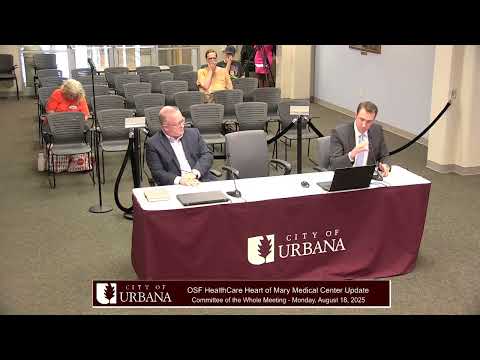
OSF HealthCare representatives told the City of Urbana Committee of the Whole that the system plans to reorganize services so the Urbana hospital becomes a behavioral-health–focused campus while shifting many specialty services to OSF’s Danville and Bloomington hospitals. JT Barnhart, president of OSF HealthCare for the Urbana and Danville hospitals, and Chris Manson, vice president of government relations, presented the proposal and answered council questions.
The plan would keep the Urbana emergency department open as a basic ER and expand inpatient behavioral-health capacity on the Urbana campus. “We will continue to have a 26‑bed adult behavioral health unit that was existing when we purchased the facility,” JT Barnhart said, adding that the hospital will convert medical floors into two private behavioral units — a 13‑bed young‑adult unit and a separate 13‑bed geriatric psychiatric unit — and a 25‑bed medical unit for patients who need medical stabilization before transfer to behavioral beds.
Barnhart said OSF provided $13 million for renovations and that the system also secured about $500,000 for emergency‑room renovations to increase space for behavioral‑health patients. “We will have additional behavioral health rooms in conjunction to the rest of the ER,” Barnhart said. Chris Manson added that telehealth and digital tools will continue to be used to connect ER patients to specialists when needed.
The presenters described workforce plans: OSF said it made offers to roughly 88% of current Urbana staff and expects about 65% of those employees to remain with the system in Urbana, Danville or Bloomington. “We will have still about 250 staff members that will work in the Urbana Hospital,” Barnhart said. Council members asked specifically about ER staffing, pediatric or adolescent beds, and whether reproductive or other services would be limited by OSF’s Catholic ethical directives; the presenters said adolescent beds would not be part of the Urbana campus as proposed and that they were not aware of any religious‑directive limitations affecting behavioral‑health services.
OSF described market drivers for the change. Barnhart said the Urbana campus currently has about 5,600 primary‑care patients (roughly 2.5% of the county population) and a local market share near 8.5%, and that recruiting primary‑care providers and building referral networks has been difficult. By contrast, the Danville hospital serves Vermilion County and has higher demand for specialty services and a larger Medicaid payer mix. Barnhart said Danville historically transfers about 200 patients a month for specialty care to centers in Champaign, Bloomington, Peoria and beyond; shifting specialty services to Danville is intended to concentrate resources where need and payer mix are greatest.
OSF said the next formal step is the state Certificate of Need (CON) process. The presenters told the council that the Illinois Health Facilities and Services Review Board (HFSRB) will hold a public hearing on August 21, 2025, at 1:00 p.m. in Urbana City Council Chambers and that the full CON board will meet on September 25, 2025, to vote on the proposal. Members of the council and staff flagged opportunities for local collaboration — notably on transportation, emergency transfers and alternative police response pathways for people with behavioral‑health needs — and OSF said it has begun conversations with the county sheriff and local police departments.
No formal council action was taken at the meeting; OSF’s presentation was informational and council members requested follow‑up information and public notice details for the CON hearing.