Get Full Government Meeting Transcripts, Videos, & Alerts Forever!
Get email alerts on the Hospital Services Certificate Of Need topic
No spam. Unsubscribe anytime.
OSF proposes deep cut to services at Urbana’s Heart of Mary, plans inpatient behavioral-health expansion; state hearing set Aug. 21
Summary
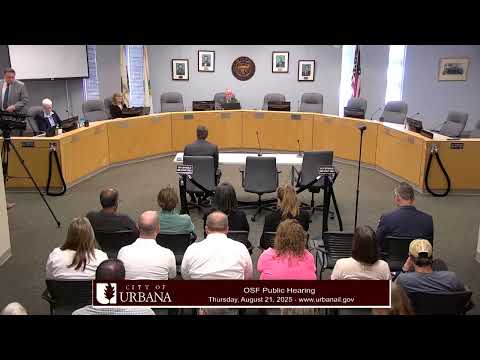
OSF HealthCare has filed a certificate-of-need request to reduce multiple inpatient services and beds at Heart of Mary Medical Center in Urbana and convert space to expanded behavioral-health units; a public hearing on the proposal was held Aug. 21, 2025.
Urbana — OSF HealthCare has filed a certificate-of-need request to cut several inpatient services and reduce beds at Heart of Mary Medical Center in Urbana while converting space to expanded behavioral-health care, officials said at a public hearing Aug. 21 in Urbana.
JT Barnhart, president of OSF HealthCare for the Urbana and Danville hospitals, told the Illinois Department of Public Health–facilitated hearing that the system proposes to reduce the hospital’s medical-surgical bed complement from 110 to 25 beds, discontinue pediatrics, intensive care, comprehensive physical rehabilitation, open-heart surgery and cardiac catheterization services, and reduce the hospital’s overall licensed bed count from 156 to 40. The hospital’s street address listed in the filing is 1400 West Park Street, Urbana, and the applicants indicated there is no project cost listed for the conversion.
Why it matters: The change would remove several inpatient specialty services currently available in Urbana and redirect resources toward an expanded behavioral-health program OSF says is needed regionally. Public commenters at the hearing raised concerns that reducing medical and surgical services at Heart of Mary will increase transfers to other hospitals, limit local access to emergency admissions that require specialty care, and disproportionately affect low-income patients who face transportation barriers.
OSF’s proposal and planned behavioral-health program
Barnhart said OSF acquired the two local hospitals roughly eight years ago and has struggled to build a primary-care referral base in Urbana. “We currently only have about 5,600 patients in our primary care panel,” Barnhart said, and OSF’s market share at Heart of Mary is “a little over 8 and a half percent,” he said. He described a plan to consolidate Heart of Mary and Sacred Heart Medical Center (Danville) under a single hospital license with two campuses and to shift many specialty services toward Danville while keeping an emergency department and a limited acute medical capability in Urbana.
Carol Friesen, chief executive officer for the Eastern Region for OSF HealthCare, described specific behavioral-health investments OSF plans for the Urbana campus. She said OSF has provided approximately $13,000,000 in capital to convert former medical units into: a 13‑bed young‑adult (18–26) inpatient behavioral‑health unit with private rooms; a 13‑bed geriatric psychiatric unit with private rooms; and a 25‑bed medical‑behavioral unit to provide medical clearance and medical care for patients with psychiatric diagnoses. Friesen said OSF will also invest roughly $500,000 in emergency-department renovations and expects to retain ancillary services (imaging, pharmacy, food service) and ambulatory behavioral-health clinics. She said OSF expects roughly 225 staff will be required to operate the revised Urbana campus, and that OSF has subsidized operating losses at Heart of Mary since acquisition.
Public testimony: access, capacity and trust concerns
Several physicians, nurses and long-time residents opposed the downsizing of inpatient medical and surgical services and questioned whether the behavioral-health expansion must come at the expense of existing services. Vascular surgeon Ravi Hassanadka, who identified himself as a former OSF and Christie Clinic provider, said he opposed the change in the certificate of need because it “decreases much-needed medical services” and argued OSF could expand psychiatry without eliminating other services. He told the board that operating-room and cath-lab closures already in effect have increased transfers and that Carle (Carle Foundation Hospital) routinely runs at capacity, which could limit local options for patients who would have been admitted to Heart of Mary.
Other commenters described personal ties to the hospital and concerns about community access. An Urbana resident who said she was treated in OSF’s rehab unit recounted her positive experience and urged the board to consider preserving rehabilitation services. An EMS provider and parent raised concerns about pediatric and cardiac access for families without reliable transportation. Former hospital staff and long-time volunteers described the hospital as a “town” institution and said the loss of services would be traumatic for employees and patients.
Board process, timeline and how to comment
The hearing was conducted by staff of the Illinois Health Facilities and Services Review Board under the Illinois Health Facilities Planning Act. The public hearing record opened Aug. 21 in Urbana. Board staff announced the state board has tentatively scheduled consideration of the project for the Nov. 18, 2025 meeting of the Illinois Health Facilities and Services Review Board in Bolingbrook. Written comments for the record are due Oct. 29, 2025, and may be mailed to the Illinois Department of Public Health (525 West Jefferson Street, Second Floor, Springfield, Illinois 62761) or submitted via the board’s posted email address. The hearing notice and staff remarks stated that allegations about need should be supported by two copies of supporting documentation.
What the hearing did not decide
This public hearing was an opportunity for comment only; the state board must still vote on OSF’s requested certificate-of-need revision. No vote was taken at the Urbana hearing. Transcript testimony included differing factual claims about current utilization and staffing; the board’s final decision will rest on the evidence in the record and the criteria in state law.
Ending
The Illinois Health Facilities and Services Review Board staff closed the hearing after inviting any additional testimony and reminding attendees of the Oct. 29 written‑comment deadline and the board’s Nov. 18 consideration date. The public record for Project 25026 will include the oral testimony given Aug. 21 and any written submissions received before the deadline.