Get Full Government Meeting Transcripts, Videos, & Alerts Forever!
Get email alerts on the Housing And Community Development topic
No spam. Unsubscribe anytime.
Urbana holds hearing after HUD tells staff to remove prior‑year rollovers from current consolidated‑plan budgets
Summary
City staff told the Community Development Commission that HUD required prior‑year committed funds be removed from future action‑plan budget columns, making the current draft appear to have less available funding; a public comment period runs through Sept. 4.
The City of Urbana Community Development Commission held a public hearing Tuesday to review a revised draft of the city’s 2025–29 consolidated plan and the 2025–26 annual action plan after the U.S. Department of Housing and Urban Development asked staff to stop showing prior‑year committed rollovers in future budget columns.
Interim Grants Division Manager Nick Olsen said the change is primarily a formatting and accounting adjustment requested by HUD. “The guidance that we’re now getting from HUD is that, those funds are basically accounted for already in prior year action plans, and we don't need to be including them in our budgets moving forward,” Olsen said.
The consolidated plan frames needs and goals over a five‑year period; the action plan covers the first year of that period and lists specific projects and budgets. Olsen told the commission the HUD review focused on how prior‑year balances were displayed: funds already committed to multi‑year projects should not be double‑counted in subsequent action‑plan budget columns. As a result, the draft circulated in August shows a smaller amount of resources available for FY2025–26, although Olsen said some rollover funds remain available and will be used consistent with the original action plans.
Key numbers in the draft as presented by Olsen include a FY2025–26 allocation estimate of $392,195 in Community Development Block Grant (CDBG) funds and $633,154 in HOME funds. Five‑year estimates in the draft show just under $2.5 million in CDBG and a little over $3 million in HOME, which Olsen described as planning estimates based on prior years and not final allocations: “We don't know our allocations until Congress sets the federal budget each year.”
Olsen said HUD allowed the city to rebudget a balance of previously uncommitted prior‑year CDBG funds totaling $478,303 for the FY2025–26 budget. He described the larger set of prior‑year balances shown in red in the draft as committed to ongoing projects and therefore removed from the current year’s budget columns to avoid double counting.
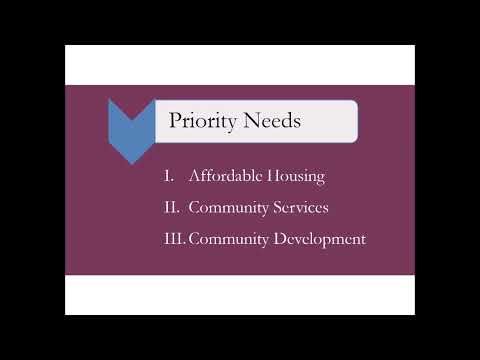
The draft ties dollars to the plan’s priority goals. For FY2025–26 the draft budgets include: invest in affordable housing — $85,000 in CDBG and $470,154 in HOME; support households in need — $228,195 in CDBG and $100,000 in HOME; encourage community and economic development — $478,302.86 (this line is primarily the rebudgeted rollover). Project‑level FY2025–26 amounts cited in the presentation include $5,000 for property acquisition/demolition/new construction, $35,000 for code enforcement, $58,000 for public services, $128,000 for housing rehabilitation, approximately $43,000 for housing program delivery (activity‑specific staffing), $378,302.86 for public infrastructure, and $100,000 for economic development. HOME program line items shown include $63,000 for planning and administration, $150,000 for community housing development organization (CHDO) support (organizations historically named in the plan include Habitat for Humanity of Champaign County and First Followers), and $100,000 for tenant‑based rental assistance.
Olsen reminded the commission that CDBG funds are restricted to activities within Urbana’s municipal boundaries, while HOME funds are disbursed through the Urbana Home Consortium (Urbana, the City of Champaign and unincorporated parts of Champaign County) and are eligible for use across that consortium area. He also noted the draft includes a map showing the city’s HUD program target areas and that the consortium geography can be viewed in HUD’s CPD maps tool.
Commissioners asked clarifying questions during the presentation. One commissioner asked whether accessory dwelling units (ADUs) were funded in the draft; Olsen said the plan’s market analysis references smaller housing types as a potential option but “We haven't dedicated any funds specifically to that activity.” Another commissioner pressed for a clearer distinction between surplus and unexpended prior‑year funds; Olsen agreed and said the HUD direction should simplify accomplishment tracking by keeping draws tied to their initial action plan years.
The revised draft was published for public comment from Aug. 6 through Sept. 4, 2025; staff said written comments will be accepted until Sept. 4 at 5 p.m., and the final draft incorporating comments will be submitted to HUD after that period. Olsen said because the draft remains in that comment stage the revisions do not require a formal amendment or a vote at this meeting.
The city plans to publish a draft Consolidated Annual Performance and Evaluation Report (CAPER) for the prior fiscal year in September and to hold a public hearing on the CAPER at the commission’s regular meeting that month.