Get Full Government Meeting Transcripts, Videos, & Alerts Forever!
Get email alerts on the Public Plaza topic
No spam. Unsubscribe anytime.
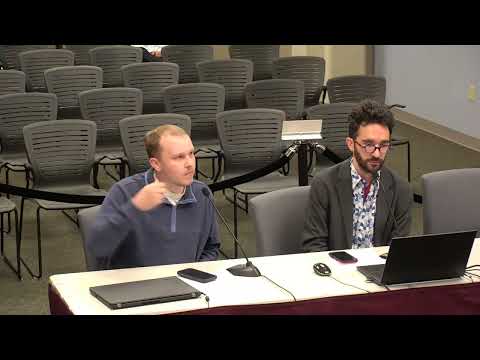
U. of Illinois students show conceptual plaza for Rose Bowl parking lot to Urbana council
Summary
University of Illinois architecture faculty and students presented a conceptual plaza design to the Urbana City Council committee of the whole, proposing a permanent public plaza on the city-owned parking lot immediately north of the Rose Bowl Tavern.
University of Illinois architecture faculty and students presented a conceptual plaza design to the Urbana City Council committee of the whole, proposing a permanent public plaza on the city-owned parking lot immediately north of the Rose Bowl Tavern.
Professor Joseph Altschuler, assistant professor of architecture at the University of Illinois Urbana-Champaign, introduced the project and emphasized the work is speculative: “I wanna make clear … this is not a commission. This is not intended to be built as shown.” Graduate student Jake Rhodes said the studio found “there’s actually no shortage of programming. What there is is a shortage of venues,” and framed the design as a way to create more flexible downtown spaces.
The students developed the schematic as a class project during spring 2025, informed by the city’s 2022 Urbana downtown public realm study and consultations with Rose Bowl representative Charlie Harris and Urbana’s public realm team. Their proposal focuses on the two lobes of the city-owned lot immediately north of the Rose Bowl and sketches three concentric “radiuses” of activity: a pivot point linking Goose Alley to the plaza, loitering and hangout space adjacent to the Rose Bowl, and a flexible stage that could support formal concerts or informal gatherings.
Design elements shown in renderings and a physical model include built-up stadium seating, movable seating, permanent shading, trees and a mix of vegetated and hardened surfaces. The students also proposed environmental graphics and wayfinding to link the plaza to cultural assets downtown and to reinforce a local visual identity. The presentation notes the wider downtown area contains about 4,500 parking spaces in total (an aggregate figure cited from earlier studies), of which roughly 1,300 are city-owned; the students said the proposal would impact about 46 spaces in the two lobes immediately north of the Rose Bowl.
Council members asked about outreach to adjacent businesses. Altschuler said the studio had worked closely with the Rose Bowl throughout the semester, that Rose Bowl staff were “really excited” about the concept and viewed the site as a potential public square rather than solely a business activation. He said Bunnies (a neighboring business whose lot intersects the schematic) had not been engaged during the semester but that meaningful engagement with property owners and businesses would be part of any next steps. Urbana public realm staff who contributed to the project were named during the presentation: Kevin Garcia, Vivian Krishnan and Olivia Jovine.
Council members praised the collaboration with the university and noted the proposal could be advanced incrementally. Altschuler and Rhodes suggested intermediate steps—artistic activation, surface treatments and environmental graphics—that could expand the plaza’s footprint and test impacts on parking and business access before any permanent reconstruction. The presenters repeated that the work represents an academic, conceptual design that would require further community engagement, funding decisions and formal approvals before construction could occur.
A physical model built by the students was placed at the room entrance for council members and the public to view, and the presenters welcomed additional feedback. No formal action, funding request or ordinance was introduced by council during or after the presentation. A procedural motion during the presentation extended the presenters’ time and passed by voice vote.
The project ties back to the city’s 2022 public realm study and ongoing downtown activation by the Rose Bowl. The presenters encouraged the council to view the proposal as the start of a longer community conversation about how underused downtown parking might be reallocated for public space in phases that protect business interests while testing new public-realm strategies.