
Regional Planning Commission presents $81.2 million provisional FY2026 budget, flags federal funding risk
Get AI-powered insights, summaries, and transcripts
Subscribe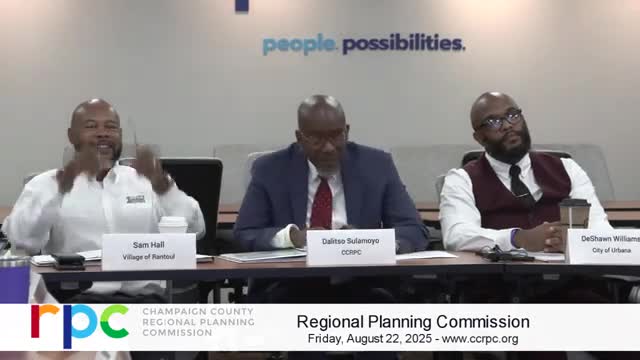
Summary
The Champaign County Regional Planning Commission presented a provisional FY2026 budget showing $81.2 million in revenues, $82.0 million in expenditures and 383 budgeted full‑time equivalents, while staff warned that changes at the federal level could force program adjustments.
The Champaign County Regional Planning Commission on Aug. 10 presented a provisional fiscal year 2026 budget that forecasts $81,204,251 in revenue and $82,000,009 in expenditures and budgets 383 full‑time equivalents. The commission’s presenter described the plan as a “status quo” budget based on current federal and state funding assumptions.
The budget matters because the commission administers multiple federally and state funded social‑service programs in Champaign County and surrounding counties; staff said about 94% of the RPC’s budget relies on state and federal grants. The presenter told commissioners that administrative costs are budgeted at 5.2% of the total, well below federal and state allowances.
In the presentation staff described the budget as organized across seven funds. The general operating fund (fund 2075) is shown with a fund balance of $2,896,002 and revenue and expenditures of about $37,000,000; that fund includes emergency rental assistance, planning, developmental‑disability services and other social services. Staff noted a $700,000 receivable tied to a loan for an affordable‑housing project in the city of Champaign that is expected to be repaid in a future year and is included in the fund balance.
Other funds described include a separate police training fund (2060) created after a state request, an early childhood/Head Start fund (2104) with budgeted revenues and expenditures of about $20.16 million serving 509 preschoolers and 261 infants/toddlers, an indoor climate research and training fund (2109) that carries timing‑related deficits tied to state reimbursements, a workforce development fund (2110) with a projected deficit because of reimbursement timing, and two economic development/loan funds (USDA loan fund 2474 and economic development fund 2475) used for low‑interest loans and revolving loan activity.
Commissioners asked about forward planning if federal appropriations are reduced. Staff described scenario planning carried out earlier in 2025 that models 25% and 50% funding reductions and said the commission has contingency plans but has not yet implemented any reductions. Staff also warned that potential federal rule and appropriation changes could affect which populations programs may serve and could require policy or operational adjustments.
Discussion also touched on timing differences between grant fiscal years and the commission’s program fiscal years and how that timing affects fund balances. No formal vote was taken on the budget during the meeting; the document was presented for review and will be considered again as part of the county board process and when a compensation plan is finalized.
The commission scheduled further budget discussion tied to the county board review and to any compensation plan staff expect to present in November.