Get Full Government Meeting Transcripts, Videos, & Alerts Forever!
Get email alerts on the Juvenile Services Budget topic
No spam. Unsubscribe anytime.
Christian County commissioners approve juvenile-related court budgets and shift two legal positions to juvenile office
Summary
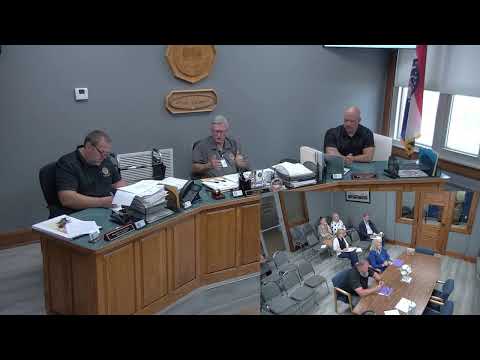
Christian County commissioners voted Aug. 11 to approve the consolidated District 1 and District 2 court budget proposals for 2026, including a planned shift of an attorney and a paralegal from the prosecuting attorney’s budget to the juvenile office.
Christian County commissioners voted to approve the consolidated District 1 and District 2 court budget proposals for 2026 during their Aug. 11 meeting, a package that includes transferring two existing legal positions — an attorney and a paralegal — from the prosecuting attorney’s office to the juvenile office and relies on state and grant funds to cover portions of the costs.
Judge Johnson, who presented the consolidated courts budget (which combines the circuit clerk and circuit court budgets), told commissioners the proposal covers both Division 1 and Division 2 court operations and explained that some line items reflect position transfers rather than new hires. "As a practical matter, Barb prepares the circuit clerk's budget. I prepare the circuit court budget," Johnson said while describing how the consolidated budget is constructed. He said the attorney and paralegal assigned to juvenile work have been supervised through the prosecutor’s office and that moving them to the juvenile office is intended to remove recurring conflicts of interest.
The budget discussion focused on three recurring themes: supervision and authority when county and state employees work in the same office, the funding sources that offset county costs, and program priorities that could be supported with new opioid-settlement funds. Perry, the county’s chief juvenile officer, described the attorney and paralegal as existing positions that would be transferred from the prosecutor’s budget to the juvenile budget without increasing pay. "These are not new positions. Nothing is being done to change the amount of pay; they're simply being shifted," Perry said.
Commissioners pressed for details about supervision and employment status. Commissioners asked whether shifting the positions would change benefits or create supervisory conflicts because the juvenile office already includes both state-paid and county-paid employees. County staff and the county’s HR representative said the arrangement has worked historically but acknowledged some liability and recommended clarifying responsibilities in writing. The HR director suggested that a memorandum of understanding (MOU) could help clarify roles, while Judge Johnson noted that the statutory appointing authority for the juvenile division remains the court and that court rules and statutes govern those positions.
Budget reductions and offsets were discussed in detail. Perry said that the juvenile office has secured recurring grants that significantly reduce the county’s net obligation: a locally managed grant that began years ago has grown from $5,000 to about $119,000 (renewed for a three-year term), and additional state grant increments of roughly $10,000 annually have been obtained. Perry and Judge Johnson said those grants will help cover counseling, risk assessments and other services. The presenters also noted the county expects additional opioid-settlement payments over coming years and discussed using that funding to expand or stabilize treatment-court services; commissioners described preliminary estimates of incoming opioid-settlement funds as approximately $500,000 available to the county across multiple checks but said exact timing and amounts will be confirmed by the county treasurer and the county’s settlement attorney.
Commissioners asked that juvenile staff provide clearer, regular updates to the commission. Presiding Commissioner Lynn Morris asked Perry to begin quarterly reports describing juvenile caseloads, deadlines, pretrial services usage and program needs so the commission can better understand operations, budget pressures and service demands. The commission also heard that certain pretrial-service costs (GPS monitoring and drug testing for indigent defendants) have risen and that staff will work with the prosecutor’s office to review recommendations for pretrial services and constrain growth within the current budget where possible.
Formal action: a commissioner moved and the commission voted to approve the District 1 and District 2 budgets for 2026 as presented. The motion passed; commissioners recorded their assent with oral "aye" votes.
Why this matters: The budget and staffing shifts affect supervision lines and the management of state-paid and county-paid employees inside the juvenile office, could slightly raise county payroll costs over time (offset by grants in the near term), and shape how new opioid-settlement dollars and other grants are used for treatment courts and juvenile services. Commissioners signaled interest in an MOU or other clarifying documentation and asked for regular performance and caseload reporting from juvenile staff.
The commission scheduled further budget follow-up at its regular Thursday meeting and asked juvenile and prosecuting-office staff, the auditor and HR to prepare additional details and any proposed MOU language for that session.