Get Full Government Meeting Transcripts, Videos, & Alerts Forever!
Get email alerts on the Planning And Zoning Training topic
No spam. Unsubscribe anytime.
Fenton planning commission receives refresher on zoning, plats, variances and Sunshine Law
Summary
The Fenton Planning and Zoning Commission held a workshop training on the commission’s duties, legal standards and procedures for rezonings, special-use permits, site and sign plans, subdivisions and Sunshine Law obligations.
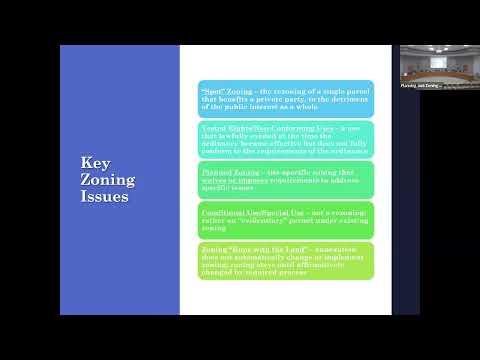
FENTON — The Fenton Planning and Zoning Commission held a workshop training session focused on the commission’s duties, procedures and legal limits, covering comprehensive plans, zoning, special-use permits, site and sign plan review, subdivisions and plats, variances, and open-meeting (Sunshine) requirements.
Trainer Aaron (staff member) told commissioners that the comprehensive plan is the long-range policy guide for land use and that the zoning code is the local law adopted to carry out those goals. “The thing you are mainly solely that is your responsibility … is the comprehensive plan,” Aaron said during the training.
The training explained why rezonings are reviewed under a fairly-debatable standard (deference to the local government where reasonable arguments exist) while administrative actions such as special-use permits (SUPs) and site-plan reviews require substantial evidence in the record. “If an applicant comes with a traffic study … it is not adequate for you to rely on testimony from the public saying they feel there’s going to be a traffic issue,” Aaron said, stressing that administrative decisions must be supported by evidence in the record.
Commissioners were also reminded that site-plan review and SUPs are related but distinct: the SUP determines whether a use is permitted with conditions, and the site plan examines how that use will operate on a particular site. A commissioner asked whether the SUP must be decided before site-plan review; Aaron said the city generally would not process the site plan before confirming the use is permitted.
On subdivisions and plats, the trainer described the difference between discretionary rezonings and ministerial plat approvals. “If it meets your code, you have to grant it. There is absolutely no discretion,” Aaron said of plat approval, and he noted that courts generally treat a city’s plat approval as administrative and not a basis for liability when downstream problems occur.
The session covered the board of adjustment’s role in hearing appeals and granting variances (practical-difficulty standard) and emphasized that use variances are difficult to obtain. The commission was introduced to the city’s sign-plan mechanism as an alternative to the board of adjustment for routine sign deviations.
Aaron reviewed conflicts-of-interest, appearance-of-bias rules, ex parte communications and the Sunshine Law. Commissioners were warned that a quorum discussing public business outside a noticed meeting, including by email or text, can trigger a Sunshine Law violation and potentially void actions. Aaron advised that emails involving a quorum should be cc’d to the city clerk so the messages are retained as public records.
The trainer cited recent court decisions as illustrations: a case in which grading and site preparation were found by a court to satisfy a contract/ordinance requirement to “start construction” within one year, and another case involving an overlay district and pre-enforcement takings claims. He also recited the statutory notice requirement for certain public hearings and recounted a case in which failure to repeat a published newspaper notice led to a court voiding an ordinance amendment.
No land-use permits, rezoning decisions or variances were considered during the workshop. The commission made one formal administrative motion to adjourn the workshop and reconvene for the regular meeting at 7 p.m.; the motion was seconded and approved by voice vote.
The training included reminders about specific thresholds and procedures discussed in the session: 15-day newspaper notice for certain hearings (as discussed in the training), Sunshine Law’s 24-hour tentative-agenda notice requirement, the 30-day window referenced for escrow release procedures, and the 50 percent destruction threshold for nonconforming structures noted in the trainer’s examples.
The workshop concluded with Chairperson Newman calling for the adjournment and reconvening at 7:00 p.m. for the regular meeting; the voice vote was recorded as “Aye.”