Get Full Government Meeting Transcripts, Videos, & Alerts Forever!
Get email alerts on the Municipal Governance topic
No spam. Unsubscribe anytime.
Fenton aldermen receive annual training on Missouri municipal law, Sunshine rules and conflicts
Summary
The city attorney led an annual training for the Fenton Board of Aldermen covering statutory limits under Dillon’s Rule, recent changes to Missouri’s Sunshine Law, record-retention and public-record procedures, conflict-of-interest and voting rules, and limits on email/text communications among a quorum.
The city attorney led the Board of Aldermen of Fenton through its annual training session on municipal law and governance, emphasizing statutory limits, recent changes to the Sunshine Law and rules about conflicts of interest, record requests and meeting procedure.
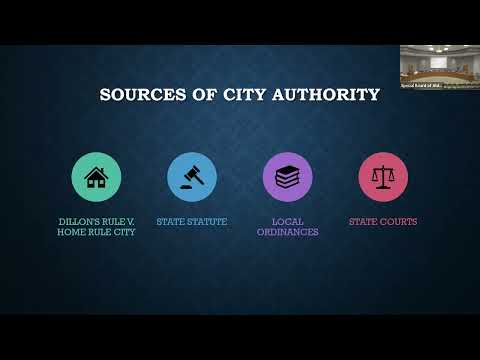
The training focused on why Fenton, as a statutory fourth-class city, must follow the authority granted in state law rather than the broader powers available to home-rule (charter) cities. "We always start with kinda city introduction... what authorities we're coming from," the city attorney said, noting the need to consult Missouri Revised Statutes chapter 79 when the city considers new regulations.
The presentation highlighted recent and pending legislative developments the city attorney said affect local practice. On the Sunshine Law (Chapter 610, RSMo), the attorney described an expected amendment exempting minors’ personal information from public disclosure, and said the law now (or will soon) permit charging for research time on large record requests and treating abandoned serial requests as abandoned if the requester does not respond in a reasonable time. "Don't reply all," the city attorney warned when discussing email chains among aldermen to avoid creating a meeting among a quorum.
City legal guidance included procedural requirements and penalties. The attorney reminded aldermen that ordinances must be introduced as a bill, read twice (by title or in full), signed by the mayor or overridden by a two-thirds vote of the full membership to become law, and that ordinances require a majority of the full membership (five of eight). The mayor may veto; overriding a veto requires two-thirds of the full membership (six of eight). The attorney also described quorum and voting math: a quorum is five members, and when only five members are present a unanimous vote is needed to pass an ordinance.
On closed sessions and records, the attorney summarized common lawful bases for closing a meeting (legal actions, real estate negotiations where publicity would affect price, and personnel matters) and noted that closed-session discussion must stay within the noticed reason for the closed session. For open-records procedure, the attorney said the city has three business days to respond to a records request but must produce readily available items sooner and can request more time with written notice when research is substantial.
Conflict-of-interest and ethics guidance was explicit: the attorney said Missouri conflict statutes focus on financial gain and require recusal when a member stands to profit; nepotism rules extend to relatives within the fourth degree and step-relations. The attorney recommended disclosure when a past relationship might create an appearance issue and recusal when appropriate.
Other practical guidance covered Robert’s Rules of Order and how Fenton operates in practice; the role distinction between the board (legislative) and the mayor (executive), and the city administrator as the day-to-day operations lead. The attorney noted that under the city’s district rules the acting president may cast a tie-breaking vote and that abstentions are protected (citing First Amendment protections) and cannot be automatically reinterpreted as a “no.”
The session closed without adopting new city policy. The only formal action recorded in the transcript was a procedural motion to adjourn, which passed after a motion by Roger and a second by Harold.
The training included multiple opportunities for questions from aldermen and practical reminders intended to reduce Sunshine and conflict risks — for example, forwarding quorum-level communications to the city clerk for retention and avoiding group text chains about city business.