Get Full Government Meeting Transcripts, Videos, & Alerts Forever!
Get email alerts on the Zoning Variance Boundary Adjustment topic
No spam. Unsubscribe anytime.
Fenton board continues variance case for 690 South Highway Drive after petitioner fails to appear
Summary
The City of Fenton Board of Adjustment voted 4-1 on June 17 to continue a variance petition for 690 South Highway Drive after the petitioner did not attend; the board asked staff to send registered mail and warned of res judicata risks if the case is decided in absentia.
The City of Fenton Board of Adjustment on June 17 voted to continue a petition by Doring Engineering on behalf of Watson Home Properties LLC concerning variances at 690 South Highway Drive after the petitioner did not appear.
The board’s continuance preserves the petitioner’s right to due process while staff was directed to send another email and a registered letter notifying the petitioner of the new hearing date; the board recorded a 4-1 roll-call vote to continue the case to the next meeting.
At issue in case 2025BDashO1DashA was a request by Mark Doring of Doring Engineering Incorporated, representing Watson Home Properties LLC, for two variances tied to a boundary adjustment plat at 690 South Highway Drive: (1) a reduction in the minimum required lot size under the zoning code provision referenced in the staff report, and (2) allowing an existing billboard to be located closer to the adjusted lot line than the typical setback ratio described in the staff materials. The property is zoned HP-1 (Hospitality Park District), and the petition sought to create two new lots.
Community Development Director Amy Stark told the board that staff had sent two written notices and a reminder email to the petitioner and property owner, and that the petitioner had not notified staff he would be absent. City Attorney Aaron Steele warned the board that a decision rendered without the petitioner present carries legal risk because the matter is treated like a court proceeding and could be subject to challenge under the doctrine of res judicata. "The safest course is always to continue it because they are not here, and it is res judicata," Steele said.
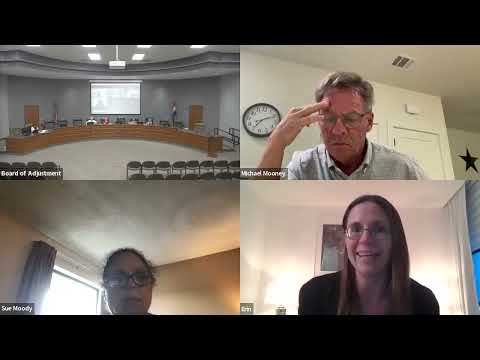
Board members debated whether to treat the absence as grounds to deny or to continue. Several members expressed frustration at repeated absences: the board was told the case first was heard in March and then continued in April and May. Vice Chairperson Mike Mooney said he preferred one more continuance to give the petitioner a final chance, noting that continuing "for 1 more period wouldn't wouldn't hurt anything." Another member argued the petitioner had been inconsiderate for failing to appear after multiple continuances.
During the discussion, Aaron Steele and other participants noted that past approvals showed development could proceed on the site without the current variances, explaining that previous development applications had been approved but not pursued. The board asked staff to include in the follow-up correspondence a clear notice that if the petitioner does not withdraw and does not appear at the next hearing, the board will hear the case and proceed to a decision.
The motion to continue carried on a roll-call vote with Member Kloss, Member Phillips Pigg, Vice Chairperson Mike Mooney and Alternate member Cruts voting yes and Member Phillips voting no (tally: 4 yes, 1 no). Staff confirmed the case will be placed on the next meeting agenda and instructed to send both email and registered mail to the petitioner and property owner.
The continuance does not change the scope of the petition or the variances requested; it merely delays the board’s substantive determination until the petitioner can present facts supporting the variance request. The board noted that approval of a variance requires a concurring vote of four members to reverse a determination of the community development director, and that any approval would be subject to written acceptance of terms within 30 days of notice, as explained in the staff materials made part of the record.
The board will revisit case 2025BDashO1DashA at its next scheduled meeting, with staff to report on delivery of the registered letter and any additional materials submitted by the petitioner prior to that hearing.