Get Full Government Meeting Transcripts, Videos, & Alerts Forever!
Get email alerts on the Annexation topic
No spam. Unsubscribe anytime.
Sherwood holds first hearing on proposed annexation code; council schedules second hearing Sept. 2
Summary
City staff proposed a new Chapter 16.81 to the Sherwood zoning and community development code to formalize annexation procedures and approval criteria. Planning staff, the planning commission and several regional groups weighed in; council took public testimony and did not make a final decision, scheduling a second hearing for Sept. 2.
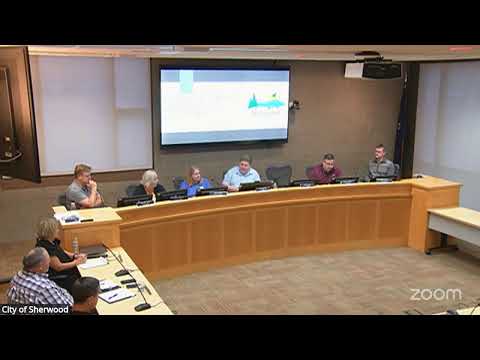
Sherwood — City staff presented the city’s first public hearing on a proposed annexation code amendment Tuesday night, asking the City Council to add Chapter 16.81 to the Sherwood zoning and community development code to establish annexation procedures, submittal requirements and approval criteria.
The proposal, described by Sean Conrad, planning manager, would codify how the city evaluates infrastructure, school capacity and long-term needs for land inside the urban growth boundary, and would apply to areas including the Tonquin employment area, the Brooklyn addition and Sherwood West. “Clear and objective standards do not apply to annexation,” Conrad said, describing the legislative nature of most annexations and the standards the draft code would use.
Staff and the planning commission recommended approval; the council opened the public hearing, took testimony from agencies and organizations and closed the hearing without a final vote. The council scheduled a second hearing for Sept. 2 to consider adoption or further amendments.
Why it matters: The draft code ties annexation findings to Sherwood’s comprehensive plan and Metro and state law, while adding specificity on infrastructure studies, annexation agreements and submittal requirements. If adopted, the code would give developers and the city more predictable procedures for bringing land into city limits and for negotiating the timing and responsibility for public utilities, transportation improvements and parks dedications.
Most important facts: Staff said the draft would require more thorough submittals than in the past, including, in many cases, transportation studies to demonstrate that a site can be served. The code would allow applicants to provide studies either for the maximum intensity allowed under zoning or for the intensity of the project they propose; staff said the code language provides flexibility so applicants are not automatically required to plan infrastructure for the absolute maximum allowed by code.
The draft also formalizes annexation agreements — contracts between the city and property owner that would “run with the land,” Eric Rutledge, community development director, told the council — to lock in timing and responsibilities for infrastructure, park dedications and potential System Development Charge (SDC) credits.
Public comment and agency input: Metro staff reviewed the public noticing and provided wording suggestions; Thousand Friends of Oregon, Housing Land Advocates and the Fair Housing Council of Oregon submitted written comments raising concerns about statewide planning goals and proportionality of studies. The Home Builders Association of Greater Portland sent a late letter urging clarity on timing and proportionality; staff said they will amend the staff report to respond in the next packet.
Council discussion: Councilors pressed staff on how the code would balance competing comprehensive-plan policies — for example, housing goals versus school capacity — and whether planning commission review should be required before council consideration. Staff said adding planning-commission review is feasible and likely would add about a month to the process but provide an additional technical review. Councilor Taylor said the state legislature’s recent actions have reduced local control and that the city must plan for worst-case infrastructure outcomes; other councilors said they want to partner with builders to reach mutually acceptable agreements.
Next steps: Because not all council members were present, the council did not adopt the ordinance. Staff recommended holding the second hearing on Sept. 2, at which the council may approve the amendment as recommended, approve with modifications, deny it or take no action. Any formal adoption would include findings tying the code to the comprehensive plan and to applicable Metro and state standards.
For now, the item remains under discussion; no final action was taken at the meeting.