Get Full Government Meeting Transcripts, Videos, & Alerts Forever!
Get email alerts on the Housing Policy topic
No spam. Unsubscribe anytime.
Sherwood staff warn new state housing bills will limit design controls, public hearings and require code updates
Summary
City planning staff briefed council on four state housing bills passed in the 2025 session — SB 974, HB 2138, HB 2258 and HB 3031 — saying several provisions limit local design standards, reduce public-hearing opportunities for some land-use decisions and require code and procedural changes; staff recommended a code audit and follow-up sessions.
Sherwood City staff told the City Council they will need a significant code update after the 2025 legislative session because new state laws restrict cities’ ability to require design standards and public hearings for a subset of housing projects and create preapproved site-plan pathways.
Eric (city staff) opened the presentation and introduced Planning Manager Sean Conrad and Carrie Richter, the city’s land-use attorney, who outlined four passed bills and their likely local effects. Conrad and Richter said the most urgent item for local code work is SB 974, which imposes waiver provisions that will prevent applying certain design standards to subdivisions and multifamily projects of certain sizes and that will shorten or eliminate public hearings for some land-use actions.
Key takeaways: SB 974 — design-waiver and process limits - SB 974 requires cities to waive certain building-design standards (facade materials, roof form, window design and similar requirements) for some multifamily projects and subdivisions in specified circumstances. Staff summarized that the waiver provisions apply to subdivisions or developments with more than 20 units; the city’s recently adopted design standards would not be enforceable on post-Sept. 26 land-use applications that meet the bill’s criteria. - The law also limits public-hearing requirements for some application types (for example, certain planned-unit developments and variances that previously led to planning-commission hearings). Richter and staff said some PUDs that now require planning-commission hearings could become staff-level decisions under the new law (effective July 1, 2026, for some provisions). The staff briefing noted appeals and procedure changes will require code updates. - SB 974 contains an expiry for the waiver provision in January 2033 (eight years), after which the city and state may reassess.
Other bills summarized: - HB 2138 (middle-housing fixes): Updates to HB 2001’s middle-housing program, including limits on requiring traffic-impact analyses and off-site improvements for small middle-housing developments (generally those of 12 units or fewer), expedited review for middle-housing land divisions and changes to cottage-cluster definitions. Staff cautioned that future rulemaking could change how discretionary and clear-and-objective paths are applied locally. - HB 2258 (Oregon Homes Bill): Directs the Land Conservation and Development Commission (LCDC) to adopt rules for preapproved site and building plans; staff described the potential for state‑approved templates to be allowed on many lots, subject to rulemaking details, and said the law could permit placement on smaller infill parcels in ways the city will need to evaluate. - HB 3031 (infrastructure funding): Provides state funding for infrastructure with conditions and reporting requirements; staff said money may be available but often carries strings that affect affordability or timing.
Council concerns and staff workload: Councilors expressed concern SB 974 could undercut the city’s ability to preserve community look-and-feel, especially for Sherwood West and planned subdivisions that typically exceed 20 units. Several council members asked whether the city could change zoning or comprehensive-plan designations to avoid the 20-unit threshold; staff warned that such changes would be complex, could conflict with housing needs analyses and would likely require comprehensive-plan updates.
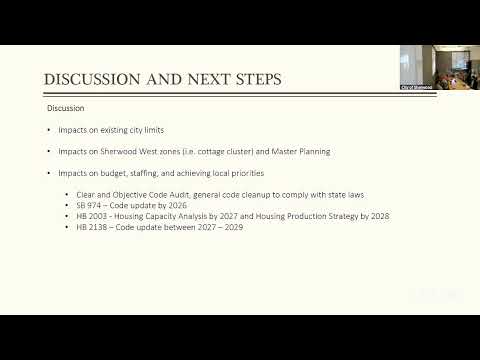
Staff recommended immediate next steps: conduct a full code audit to identify where local code conflicts with the new statutes; prioritize SB 974 code updates; begin public engagement and targeted follow-up sessions (including absent council members); and plan a multi-year workload for the planning department to implement rulemaking and local code changes resulting from the session.
No final policy decisions were made at the work session; staff will return with draft code amendments, workload estimates and potential outreach strategies.