Get Full Government Meeting Transcripts, Videos, & Alerts Forever!
Get email alerts on the Corrections Jail Expansion topic
No spam. Unsubscribe anytime.
Potter County commissioners approve talks with Burns Architecture for jail study amid debate over scope and cost
Summary
Potter County commissioners voted to proceed with modified contract negotiations with Burns Architecture to carry out an initial needs-and-concept study for the county jail after extended debate about whether to pursue an architect now, a consultant, or broader alternatives including relocation and mental-health facilities.
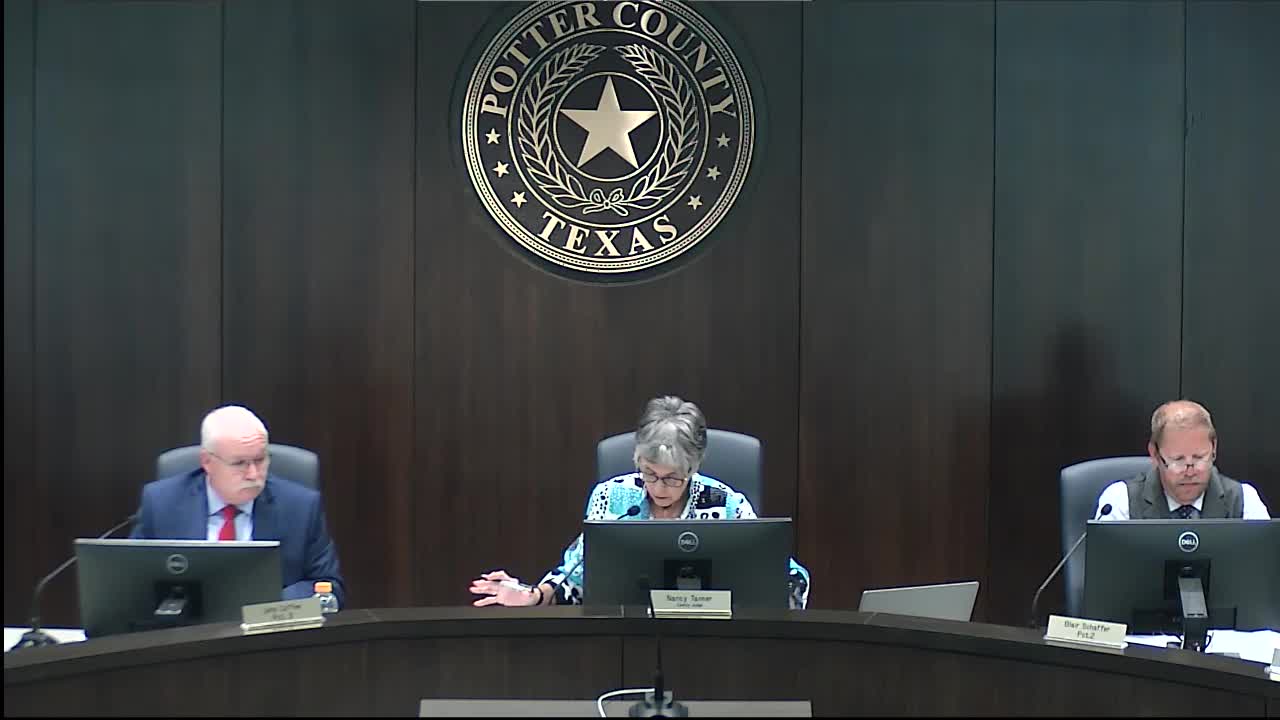
Potter County commissioners on Monday authorized modified contract negotiations with Burns Architecture LLC to begin a conceptual needs analysis and planning process for the county jail, saying they want a careful, options-based study before committing to large construction dollars.
The action follows a lengthy public discussion and presentations from Burns Architecture principal Kenny Burns, who described a two-part approach: a roughly $40,000 initial conceptual planning phase to determine needs and options, followed by larger design fees if the court decides to proceed. Commissioner Coble made the motion to enter negotiations; the court directed staff and Burns to revise contract language to make the first phase a study and bring the revised agreement back for consideration.
The vote does not finalize construction or design services; commissioners said the outcome would be a workshop and a conceptual report that explores alternatives and costs. "You cannot design a jail for $40,000. That's only to do the upfront preliminary very preliminary stuff to help you figure it out," Burns told the court, describing the first-phase scope. Burns said the firm would evaluate bed needs, alternatives (expand, rebuild, or build elsewhere), and options such as mental-health transitional facilities to reduce jail population.
Why it matters: Commissioners and county staff described long-standing overcrowding and operational stress at the jail and emphasized the stakes of committing to a high-cost project without clear, shared data. Commissioner Coble urged a cautious, methodical approach: "I make the motion that we at least go into negotiations to hire this firm, Burns firm," he said, asking that the contract emphasize a study and workshop format.
Most important facts: Burns described the $40,000 fee as the conceptual planning portion only; part 2 — full design and engineering — would be considerably more. He noted architecture/engineering soft costs often run roughly 10% of building cost as a rule of thumb but said Burns Architecture will provide transparent, itemized estimates once a scope is known. Commissioner Coble and others pressed for a study that examines adding pods to the existing jail, building a new facility (including downtown vertical options), expanding the Law Enforcement Center (LEC), and alternatives such as a mental-health transitional facility. Judge Walt Weaver, Potter County Court No. 1 judge, and other commissioners asked whether parts of the existing facility can be repurposed (for example, turning the recent booking-room remodel into a transportation hub) rather than be replaced.
On timing and next steps: The court asked Burns to convene a workshop with commissioners, sheriff's office representatives, county staff and other stakeholders to clarify scope, identify the number of beds needed, and evaluate site options. Burns said a broader analysis would take longer and likely cost more than $40,000 but that the conceptual phase would identify which scenarios require further study.
Dissent and concerns: Commissioner Coffey and others expressed concern about rushing into design or construction without full review. One commissioner recounted prior committee meetings that ended without consensus and pressed for transparency about the Texas Commission on Jail Standards facility-needs analysis and any failed inspections referenced by county staff.
Context and constraints: Commissioners noted the county's recent booking-room remodel and questioned whether the main jail is truly at the "end of useful life," an assertion raised at the May 27 meeting. Burns warned that electrical, security electronics and mechanical systems often drive large, long-term expense in older jails. The court emphasized the need to coordinate with the Texas Commission on Jail Standards and to align any study with the commission's forthcoming occupancy inspection and meeting with Brandon Wood, the commission's executive director, which Burns and county staff said could inform planning.
Ending note: The court did not approve construction work or a design contract. Instead it authorized negotiating modified language with Burns Architecture that frames the immediate work as a study and directed that revised contract return to the court for formal approval.