Get Full Government Meeting Transcripts, Videos, & Alerts Forever!
Get email alerts on the Capital Bond Public Works topic
No spam. Unsubscribe anytime.
Interim CAO: $40 million loan will be targeted to paving, drainage and priority public works projects
Summary
Interim CAO Peter Talwiston told the council the recently obtained $40 million loan will fund a mix of large and small public works projects—paving, ditch cleaning, drainage repairs and equipment—subject to council approval of specific allocations.
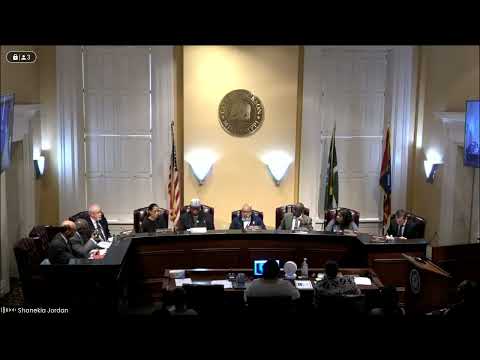
Interim Chief Administrative Officer Peter Talwiston told the Jackson City Council Sept. 4 that the city intends to direct a recently secured $40 million loan from a State Development Bank primarily to public works projects, including large corridor paving and smaller targeted work such as ditch cleaning and drainage repairs.
Why it matters: how the city allocates the $40 million will affect which neighborhoods receive immediate infrastructure repairs and how the administration balances large projects with smaller maintenance work that addresses flooding, drainage and street conditions.
Officials’ description: Talwiston said the $40 million would be used for some larger projects and for smaller projects across the city’s seven wards, prioritizing locations with flooding and critical infrastructure needs. He emphasized that any use of the loan proceeds requires subsequent council approval. He also described an effort to inventory city-owned equipment for auction to raise additional capital for public works vehicles and said he had identified roughly half a dozen pieces of heavy equipment the city could reclaim or auction — a backhoe, tractor, lowboy trailer, a cab and a camera-equipped trailer — with proceeds applied to new equipment.
Procurement and coordination: Talwiston said the administration would bring a detailed spending plan back to the council for approval. He noted that some bond proceeds are constrained by authorizing documents and cannot be applied to certain categories of spending; council members were told legal and statutory limits may apply.
Next steps: the administration will itemize projects across wards, prioritize them and return to the council with a proposed allocation plan and required approvals. Talwiston reiterated that the council must authorize spending of the borrowed funds before execution.
Bottom line: the $40 million loan is positioned as a capital infusion for public works projects, but the administration has not yet presented a ward-by-ward appropriation; the council requested a formal plan and timelines before appropriation.