Get Full Government Meeting Transcripts, Videos, & Alerts Forever!
Get email alerts on the Parks And Recreation topic
No spam. Unsubscribe anytime.
Parks director tells council budget is largely flat but warns of costly tree removals, Grove Park work
Summary
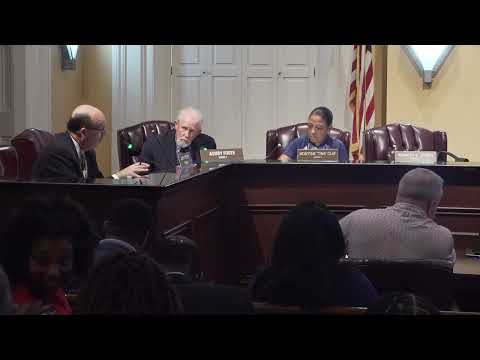
Steve Hutton, director of Parks and Recreation, told the Jackson City Council in a departmental budget hearing that the department’s operating request for fiscal 2026 is largely flat compared with 2025, but that several one-time project funds and urgent maintenance needs will require targeted spending.
Steve Hutton, director of Parks and Recreation, told the Jackson City Council in a departmental budget hearing that the department’s operating request for fiscal 2026 is largely flat compared with 2025, but that several one-time project funds and urgent maintenance needs will require targeted spending. Hutton outlined plans to map park assets, reissue Grove Park bids, address more than 500 dead trees across city parks and expand revenue efforts at Pete Brown Golf Course.
Hutton said the department moved unused salary and wage funds into an overtime line and ran Saturday crews beginning in July to catch up deferred maintenance, adding, “We typically have about 15 to 20 men that are volunteering for overtime on any given Saturday, and we’re getting very close to being caught up.”
The nut of the issue is that the operating budget itself is mostly unchanged year over year, while a separate pool of insurance-settlement and project funds will finance capital work. Hutton said a line that appears large on the budget (a page showing many zeroed recurring line items and larger 2026 project numbers) reflects sums from that insurance settlement earmarked for Grove Park, pool renovations, baseball-field work and lighting, not recurring increases to the department’s base budget.
Most immediately, Hutton said the department has flagged 502 dead trees in city parks; Jamie Fowler Boyle Park alone holds 185 of those trees. He gave a vendor-based cost range for removals of roughly $900–$950 per tree and said some vendors will do work closer to $800 per tree, a scale that would put immediate removals in the low hundreds of thousands of dollars. Hutton said the department intends to use a portion of a roughly $550,000 allocation labeled for “additional park improvements” to remove the most dangerous trees now — near roads, nursing homes and other high-risk spots — and to address more trees in future years. He said, “We’re gonna start just a little at a time and try to get the trees down that are in danger areas.”
Hutton described two-pronged tree-removal plans: hire contractors for urgent removals and rely on Public Works crews during slower seasons for less-urgent removals. Council members pressed for a middle-ground pace that balances urgency with budget limits; Councilmember (Ward) comments emphasized that removal funding, demolition capacity and disposal markets are constraints.
On Grove Park, Hutton said several bids for lighting, tennis-court work and baseball-field renovation had to be redone because earlier solicitation documents were not prepared properly. “We redid them, but then we went straight to legal with them to try to make sure that everything was correct before they go back out,” he said, and he expected some bids to be reissued as early as next week. Hutton also said a pool renovation is part of the Grove Park package and that he and a council member had met with a private donor who has “a very soft place in his heart for Grove Park Golf Course” and who may submit a private funding proposal in coming months.
Hutton highlighted revenue gains at Pete Brown Golf Course: he said rounds jumped from about 20 players per day four years ago to roughly 200 players on a typical weekend now, with weekly revenue topping $12,000 for the first time and monthly revenue exceeding $40,000 in recent months compared with roughly $4,000 monthly in the past. He cautioned that public courses normally rely on greens fees rather than tournaments for baseline revenue, but council members said improved cart paths and targeted tournaments could help further growth; Hutton estimated new cart-path work would cost in the neighborhood of $900,000 to $1.1 million if done to new-build standards.
Operational changes under way include contracting an urban-planning/tree-asset organization to create a GIS-based park inventory and asset map so the city will know which parks have playgrounds, trash cans, picnic tables, lighting and other assets before spending project funds. Hutton also said the department is installing GPS telematics on every parks maintenance vehicle to track location and fuel use, and that it is buying an autonomous (robot) mower intended for multi-field softball complexes; he said that mower can maintain a five-plex of softball fields on a 48-hour cycle and will be used initially on ball fields rather than replace staff.
Hutton and other speakers stressed the need to move routine grounds maintenance from Parks and Recreation into Public Works so Parks can focus on programming and revenue generation. Council discussion repeatedly separated three types of actions: (1) near-term safety removals of hazardous trees (direction to begin using the $550,000 project fund), (2) planned capital work tied to insurance-settlement project lines and reissued bids (direction to reissue and legal-review bids), and (3) longer-term organizational changes such as moving maintenance responsibilities to Public Works (policy/direction under review).
Council members raised public-safety and revenue questions about other park items: security lighting (Hutton said roughly $270,000 was dedicated from the insurance settlement for lighting), water leaks in parks including Livingston Park and the zoo perimeter (Hutton said he is coordinating with Public Works and Jackson Water to identify meters and fix leaks), volunteer and public–private partnership opportunities (Mississippi State University capstone projects and a memorandum of understanding with Job Corps to supply labor at the zoo), and the parks ranger program (JPD officers check parks but answer service calls first; councilmembers discussed dedicated park rangers or reserve-officer detail agreements).
The department identified about seven to eight unfilled positions and said it manages roughly 56 parks citywide. Hutton said an inventory contract would be presented to the council for approval once the proposal is finalized.
Looking ahead, Hutton said he will present the park-inventory contract and expects Grove Park bid reissues soon; council members asked staff to pursue public–private partnerships and to return with cost estimates for major demolition or capital asks. No formal motions or votes were recorded during the presentation; councilmembers limited themselves to questions and direction for staff to bring back contracts, bids and timelines.
Ending: The council kept the parks operating budget request largely flat for now but directed staff to begin safety tree removals from the specified $550,000 project fund, to present a parks inventory contract for approval, and to reissue Grove Park bids after legal review. Hutton said he will return with contract and bid timelines in the coming weeks.