Get Full Government Meeting Transcripts, Videos, & Alerts Forever!
Get email alerts on the Natural Medicine Regulation topic
No spam. Unsubscribe anytime.
Severance planning commission recommends ordinance to regulate licensed ‘‘natural medicine’’ centers in designated development nodes
Summary
The Severance Plan Commission voted unanimously Aug. 20 to recommend that Town Council adopt an ordinance (new Article 21, Chapter 16) allowing state‑licensed supervised natural‑medicine (psychedelic) healing centers in specified development node zones subject to time, place and manner controls.
SEVERANCE, Colo. — The Severance Plan Commission on Aug. 20 voted unanimously to recommend that the Town Council adopt a local ordinance (new Article 21 in Chapter 16) establishing local time, place and manner rules for state‑licensed natural‑medicine facilities, commonly described in the meeting as supervised “healing centers.” The recommendation follows state legalization and implementing regulations and would allow the use only in specified development node zones rather than across the entire town.
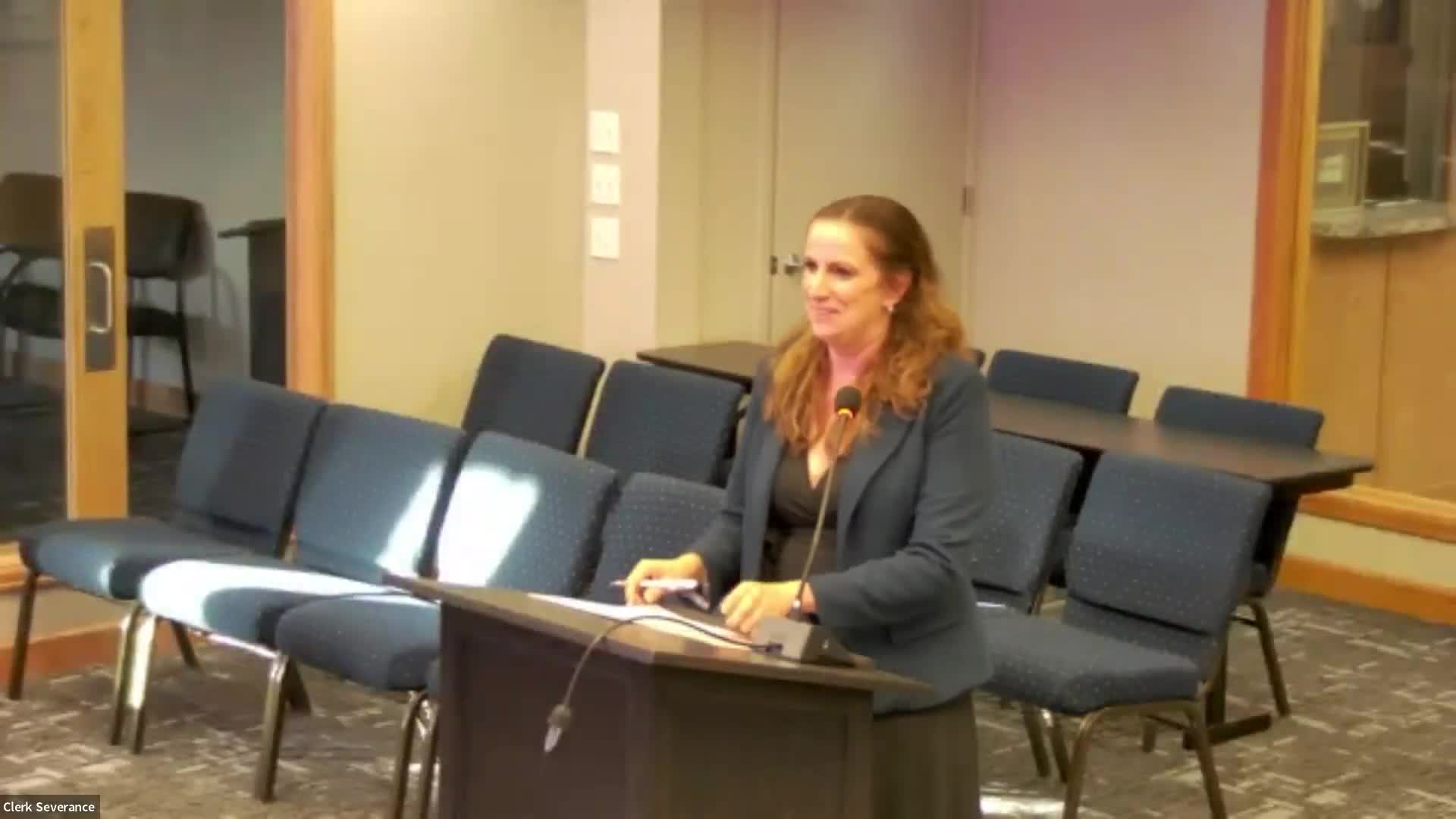
Town Attorney Nina Williams told commissioners the state — not the town — licenses natural‑medicine entities and that local government authority is limited to time, place and manner. “You can regulate hours, distance requirements, lighting, odor control and screening,” Williams said, adding that municipalities cannot enact outright bans or regulations that conflict with state rules.
Under the draft ordinance discussed at the meeting, healing centers — defined in the draft as supervised, clinical settings in which licensed facilitators provide and oversee consumption — would be permitted as‑of‑right in a limited set of development node locations. The draft also incorporates a 1,000‑foot buffer from child‑care centers, preschools and elementary and middle schools consistent with state law, and requires screening, secure storage and other nuisance protections. The draft sets operating hours Monday–Friday from 8 a.m. to 6 p.m.
Town Manager Lindsay (last name not specified in the record) noted a relevant practical consequence of the required clinical protocol: individual sessions are licensed to last about five hours, which would limit throughput to roughly two clients per practitioner per day under the proposed hours. Planning staff said that signage would continue to be governed by Severance’s existing sign code unless the code itself is amended.
Williams and planning staff emphasized that any business still must obtain the appropriate state license (through the Colorado regulatory agencies named in the meeting) and complete local land‑use review: a state license does not replace the town’s site‑plan and business‑license processes. The ordinance text discussed during the meeting also includes provisions on hours, odor control, secure disposal and a nuisance finding if required protections are not implemented.
After discussion and a request from one commissioner to clarify signage rules in the code, a motion “to recommend approval of the attached ordinance to the Town Council” was made and seconded. A roll call vote recorded all present commissioners voting yes; the commission’s recommendation will be forwarded to the Town Council for final action.
What happens next: the Plan Commission’s recommendation will appear on the Town Council agenda; the state licensing and local land‑use tracks run separately, and staff said that state preemption limits the town to time, place and manner controls rather than outright prohibition.
Commissioners and staff identified that Severance currently has four development nodes where the use could locate under the draft (the transcript lists the intersection of County Road 257 and Harmony, County Road 257 and Highway 14, and other named node locations described in the packet). The ordinance as drafted would not create retail dispensaries: products would remain on site under licensed supervision and could not be taken off premises.
The commission’s action was procedural — a recommendation to council — not a final town ordinance adoption. Town Council will review the ordinance text, including any clarifications (for example, signage language) before a final vote.