Get Full Government Meeting Transcripts, Videos, & Alerts Forever!
Get email alerts on the Lead Service Line Replacement topic
No spam. Unsubscribe anytime.
North Chicago public works committee advances IEPA‑funded plan to replace lead service lines
Summary
The Public Works committee reviewed a Phase 1 design work order and the city’s plan to use Illinois EPA principal‑forgiveness funding to replace about 900 lead and galvanized service lines; a $204,870 design work order was proposed for council approval
The North Chicago Public Works committee on Jan. 6 reviewed a multi‑phase plan to replace lead and galvanized water service lines and to use Illinois Environmental Protection Agency (IEPA) funding that can provide principal forgiveness for eligible low‑income communities.
Engineer Steve told the committee the city completed an inventory in August and identified roughly 900 lead and galvanized service lines. He said the total project cost to replace the service lines from the water main to the meter is roughly $18,000,000. The IEPA program can provide up to about $3,000,000 per year in principal‑forgiveness funding for eligible cities, and the committee was presented a plan to complete replacement over several years so the city’s covered portion would be zero if project milestones and reimbursement requirements are met.
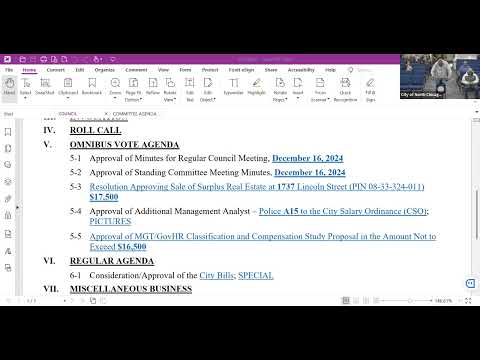
The committee reviewed a council agenda request and a proposed work order with Charter and Associates Inc. for Phase 1 design engineering and bidding services. The work order amount in the agenda draft was listed as not to exceed $204,870; the committee was told the intent is to place the work order on the next council meeting agenda for approval.
Members asked about coordination with water‑main projects and about funding risk. Steve said water‑main replacement work is handled separately but that IEPA rules now require replacement of all lead service lines within water‑main project limits, from the main to the meter. He noted the city has earlier received approximately $500,000 from a federal senator and expects an additional federal allocation (about $1.0–1.5 million) that is contingent on the federal budget becoming final.
Alderman Coleman and others asked whether the design and upfront costs could be at risk if federal or state budgets change. The committee heard that the IEPA program administering principal forgiveness and the state loan/grant pot is a state program and is not dependent on federal appropriations; federal funding discussed separately may be subject to congressional budget actions. Committee members were also told the IEPA loan/grant process reimburses the city: the city pays initial costs and submits reimbursement requests as construction and engineering invoices are incurred.
The committee’s procedural next step is to place the Charter and Associates work order on the next council agenda for formal approval; no council appropriation vote was recorded during the committee meeting itself.
Why this matters: lead service lines can expose households to lead contamination; the IEPA program can provide principal forgiveness and reduce local cost if projects conform to IEPA requirements and reimbursement rules. The committee discussion emphasized coordinating design, grant‑reimbursement timing, and concurrent water‑main projects to maximize efficiency.