
Sedalia council begins review of broad rate and fee adjustments for utilities and city services
Get AI-powered insights, summaries, and transcripts
Subscribe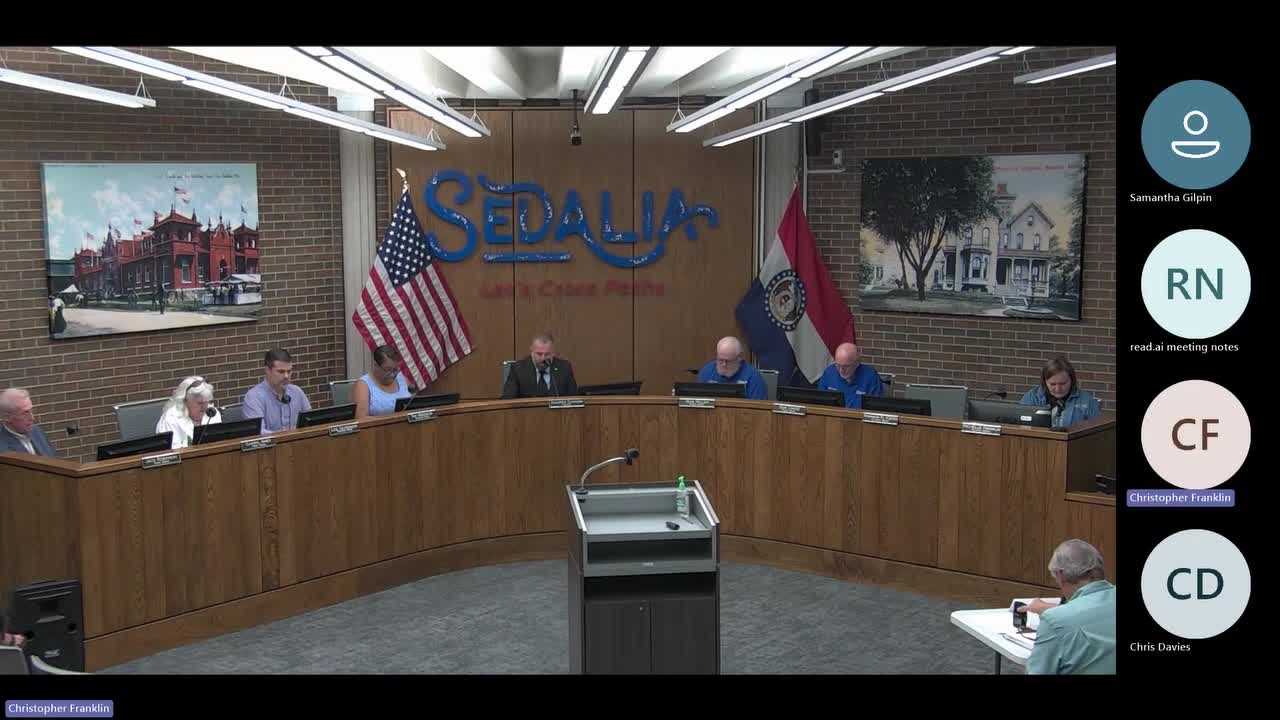
Summary
City staff presented proposed rate and fee adjustments for water, wastewater, sanitation, cemetery services and records requests, saying enterprise funds have not kept pace with inflation and deferred maintenance; council asked for more time and staff will return with a package next week.
Sedalia city officials on July 21 opened a review of proposed rate and fee changes across multiple service areas, with staff saying enterprise charges have not kept pace with rising costs and deferred maintenance. Administrator Wert told the council the city wants to adopt predictable, smaller annual adjustments instead of occasional large increases.
The review covered water and wastewater, sanitation, cemetery fees, building and planning fees, and public records charges. Administrator Wert said many enterprise funds are subsidized temporarily by the general fund or the capital improvements fund; he urged a path to ensure each service pays its true operating and replacement costs.
“Those service charges like the water and the sewer and the solid waste, they’ve gotten to the point they don’t fully cover the cost of providing these services in many instances,” Administrator Wert said, describing inflation, rising labor costs and equipment needs as drivers of the proposed changes.
Utilities staff asked for specific increases. Director of Utilities William Bracken proposed a 5 percent increase for water and a 7.5 percent increase for wastewater to address aging equipment, deferred maintenance and an underfunded fleet. Bracken said the wastewater and water systems operate as enterprise funds and must cover their own costs. He told the council staff are pursuing grants and low‑interest State Revolving Fund loans to help large capital projects.
“Over the last several years the price of all the parts and equipment that we use has went up exponentially,” Bracken said, and added that the city recently received a Department of Natural Resources grant to dredge two EQ basins that he said totaled more than $3 million.
Public works director Justin Bray presented a proposal to shift sanitation pricing toward volume-based service, offering smaller and larger cart sizes and an elderly discount. Bray outlined per‑stop landfill costs converted to a per‑gallon basis and proposed a capital improvement fee to build a replacement fund for trucks and carts rather than borrowing from the general fund.
“We would like to go to more of a usage based rates,” Bray said of the cart-size structure, and he noted that the city previously borrowed about $1.5 million from the general fund to buy garbage trucks.
City Clerk Jason Myers presented recent records‑request volumes and proposed raising hourly research charges charged under the Missouri Sunshine Law to match current salary scales; the clerk proposed raising the police research rate to about $32.22 per hour and other municipal records research to about $29.67 per hour, with a continued option to charge 10 cents per page.
Community development staff previewed a package of building and planning fee adjustments and several new or clarified fees, including fees for annexations and floodplain permits, and a proposal to uniform building, mechanical, electrical and plumbing permit charges using a construction‑cost formula used by the ICC.
Council members asked departments for additional details, including comparisons with nearby cities and the size of the likely monthly impacts on typical residential customers. No binding vote on the rate package occurred; staff said they would return with a consolidated proposal at the council’s next meeting.
The presentations are part of an annual review the administration said it performs to align service charges with operating and capital needs and to avoid large, infrequent rate jumps.