Get Full Government Meeting Transcripts, Videos, & Alerts Forever!
Get email alerts on the School Wellness Policy topic
No spam. Unsubscribe anytime.
Policy Committee approves revised school wellness policy; limits homemade classroom foods
Summary
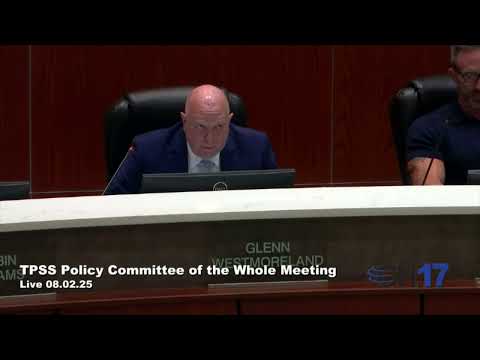
The Policy Committee of the Whole approved revisions to policy JGB on Sept. 2, aligning the district’s school wellness policy with state and federal guidelines and clarifying that most classroom food must be prepackaged; the committee said the changes will not alter current practices or approved fundraisers.
On Sept. 2 the Policy Committee of the Whole approved revisions to policy JGB, the district’s school wellness policy, adopting state and federal guidance and clarifying how schools should handle food at events and recess/physical-activity minutes. The committee voted to adopt the revisions after a brief presentation and questions from members.
A district staff member who presented the revisions said the document “took all the regulations and not only added them, but they kinda made an adjustment to where they fit the needs of [the] school system” and that adoption “will not impact anything that we are doing currently at our schools.” The presenter thanked Carolyn McPherson, identified in the meeting as the district dietitian, and noted Kendra Reed contributed to the revisions but was not in attendance.
The updated policy explicitly restricts homemade foods in school settings and requires that foods brought into schools for classroom distribution be prepackaged. A committee member asked whether common school activities and fundraisers — cited in discussion as PBIS events, popsicle rewards, pizza from vendors and fundraisers such as “Penny Power” — would be affected. The presenter replied that prepackaged items and vendor-supplied foods (for example, pizza from a commercial vendor) meet the policy’s requirements and that “nothing in this policy will impact anything that we are currently doing.”
The policy also adopts state guidance on physical activity for elementary grades. The revisions state that schools serving kindergarten through 5th grade must provide at least 15 minutes of recess; the presenter said that requirement is part of the state mandate and is folded into the district’s broader expectation of 30 minutes per day of physical activity (which can include physical education and shorter scheduled activity breaks). Committee members asked whether the 15 minutes are in addition to the 30-minute physical-education requirement; the presenter clarified the 15-minute recess requirement can be met as part of the total physical-activity time and that recess minutes may be divided (for example, combined with lunch minutes) to meet the standard.
The presenter also noted that text referring to “non-student meals” was removed from the wellness policy and will be placed in a separate policy (referred to in committee as policy EEF or EF) to address non-student meal issues in a different section of district policy.
Motion and outcome: The motion to adopt the revised policy JGB was made by Mister Toler and seconded by Mister Anthony. The committee chair opened voting and the motion carried; no roll-call tally was recorded in the transcript provided.
The committee chair closed the item and moved to the next agenda item.
The committee’s discussion focused on implementation details — how schools will schedule recess and physical-activity minutes and how the prepackaged-food requirement applies to common vendor-supplied items and school rewards — rather than establishing new restrictions on existing school practices. The presenter and committee members said scheduling is a building-level issue and that schools are working through how to meet the state-directed minutes.
Looking ahead, the presenter said staff will implement the revisions through usual school procedures; committee members asked that the final board agenda reflect the committee’s action for formal adoption at the full board meeting.