Get Full Government Meeting Transcripts, Videos, & Alerts Forever!
Get email alerts on the Education Policy topic
No spam. Unsubscribe anytime.
Bossier Parish panel reviews seven policy revisions after spring legislation
Summary
The Bossier Parish School Board administrative committee heard staff proposals to amend seven district policies to reflect recent state laws, including changes to online curriculum access, employee bullying training, student absence classifications, expulsion terms, SRO investigative authority, and behavioral health evaluations.
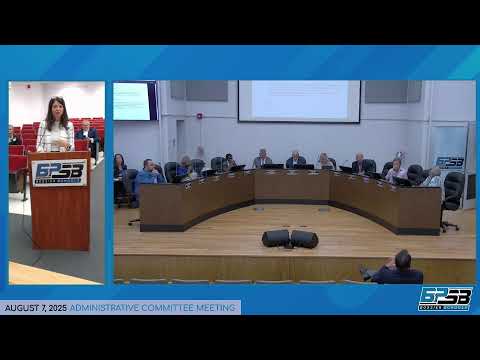
Andrea Spenny, assistant superintendent of administration for Bossier Parish Schools, presented seven policy amendment recommendations at an administrative committee meeting, asking the committee to approve revisions that align district policy with changes enacted during the most recent state legislative session.
Spenny told the committee, “I have 7 current amendments … these first 7, I'm gonna go through, and I'll just stop after each 1 and ask if anybody has any questions or comments.” She framed the package as updates required by state law rather than new policies.
The proposed changes address the following areas:
- Instructional materials (Act 103): Parents would gain access to online curriculum. Spenny said parents have long been able to review printed curriculum at schools and that the amendment extends that access to digital materials; if parents request printed copies, the district may charge a reasonable fee for printing on district machines.
- Computer access and bullying/hazing policy (Act 686): State law removed a prior requirement that schools provide classroom instruction on internet and cell-phone safety and that employees receive annual bullying-and-hazing training. Spenny said the district will still require bullying-and-hazing training for all new employees but will move to a five-year rotation for some professional-development and safety trainings to reduce annual burdens on teachers.
- Student absences and excuses: The district will simplify absence types to three categories — excused, unexcused, or suspension/expulsion — removing the prior exempt/nonexempt distinction. Spenny said the revised policy requires that students, regardless of absence type, be given the opportunity and be required to make up missed assignments.
- Expulsion (Act 497): The district proposal reflects a state change reducing a mandatory expulsion period for possession of certain weapons or illegal drugs from four complete semesters to two. Spenny said the policy language also addresses possession of marijuana and its derivatives: state language says a student “shall not be recommended for expulsion unless it's their second occurrence,” but Spenny said Bossier Schools will continue to recommend expulsion after a first occurrence.
- Child abuse reporting and SRO investigations (Act 195): Spenny said a recent change restores school resource officers’ (SROs’) ability to accept mandatory child-abuse reports directly from district employees and, where appropriate, conduct investigations. She noted an exception: allegations involving district employees must be investigated by SRO supervisors rather than the campus SRO.
- Behavioral health support for students (Act 504): The policy would allow parent-requested mental-health evaluations for students in grades 3–12 by an approved list of vetted health-care providers to take place on campus during the school day, with the evaluations “at no cost to the school board,” Spenny said.
Spenny said the amendments are the first batch the district received from Fort Dodge Consulting Incorporated Council and that additional rounds of policy changes are expected in the coming month or two. She closed by asking the committee for board approval of the recommended revisions.
Committee members asked clarifying questions during review. Mr. Newman was acknowledged after a policy explanation; Representative Bamberg, who staff said helped advance legislative changes, was noted as being in the audience. Captain Johnson and Miss Jefferson were named in discussion of SRO roles and student-services implementation.
The transcript of the meeting records Spenny presenting the package and asking for approval but does not include a formal motion by a board member, a second, or a recorded vote in the supplied excerpt. No final adoption or roll-call vote is recorded in the provided transcript segment.
The committee packet and staff comments tie each amendment to specific state acts cited during the presentation: Act 103 (instructional materials), Act 686 (computer access and bullying/hazing), Act 497 (expulsion), Act 195 (child abuse reporting), and Act 504 (behavioral health support). Spenny said the district has already updated its student handbook to reflect some changes before registration.
The proposed changes, as described by staff, are intended to align district policy with state law while preserving certain local requirements (for example, continuing required bullying-and-hazing training for new employees). The package also includes operational clarifications — such as who investigates personnel-related mandatory reports — that staff said restore previous practice curtailed by earlier law.
Spenny indicated more policy amendments will come in subsequent rounds as the district and its consultants complete reviews following the legislative session. The transcript ends with Spenny seeking board approval; a formal vote or further committee action is not recorded in the provided excerpt.