Get Full Government Meeting Transcripts, Videos, & Alerts Forever!
Get email alerts on the Utilities And Impact Fees topic
No spam. Unsubscribe anytime.
Brighton staff propose 7% water rate increase, $3 monthly storm fee and impact‑fee changes for 2026
Summary
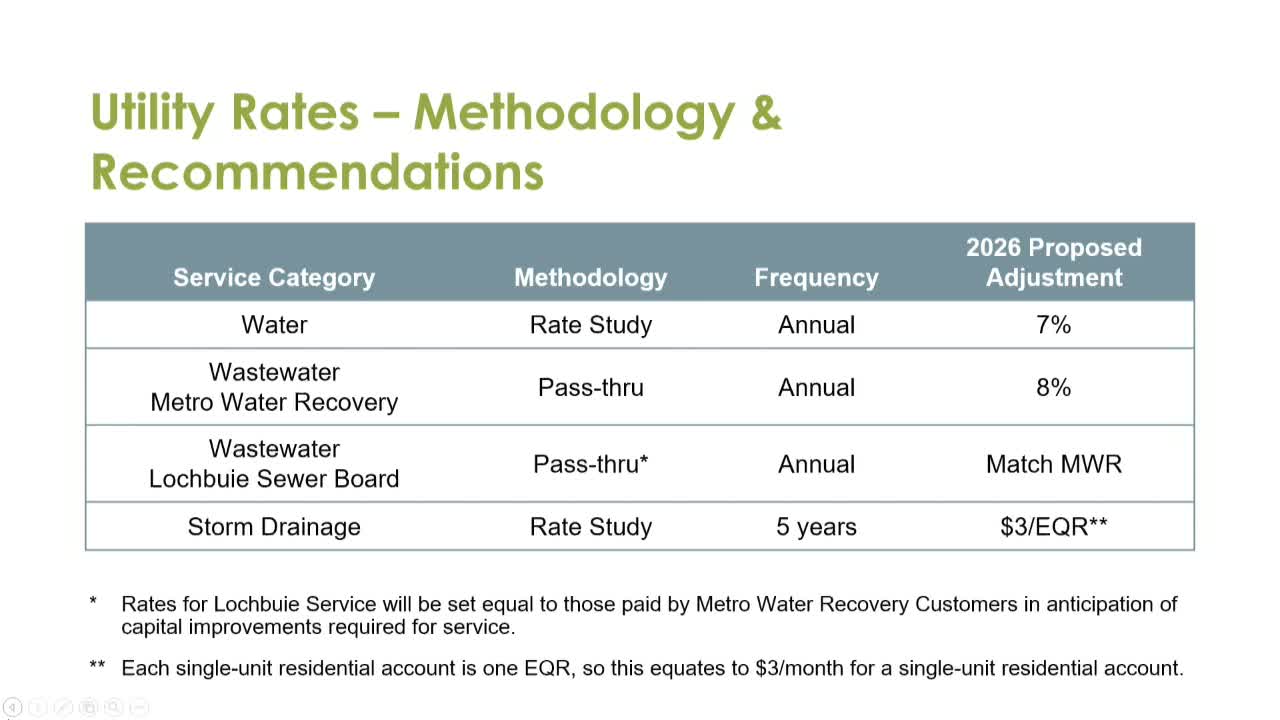
City staff recommended a 7% water rate adjustment, an 8% pass‑through from Metro for wastewater, alignment of Lochbuie sewer customers to Metro rates as an option, a $3 monthly storm drainage charge per equivalent residential unit and a phased, smaller increase in residential impact fees than a consultant originally recommended.
City finance and utility staff presented a package of proposed 2026 utility rate and impact‑fee changes to the Brighton City Council at its Aug. 26 study session, recommending a mix of percentage adjustments, a modest monthly storm fee and a staff‑recommended compromise on proposed impact‑fee increases for new development.
The finance presenter said the water rate study produced a recommended rate adjustment of 7%. “The rate adjustment proposed through that study was 7%,” the presenter said. For wastewater charges collected on the city’s behalf, Metro Water Recovery advised an 8% increase this year; staff said they were proposing to pass that increase through to customers.
The council also discussed an ongoing issue involving customers currently served by the Lochbuie sewer treatment provider. Staff said Lochbuie customers historically paid lower wastewater rates than Metro customers and recommended aligning Lochbuie rates with Metro’s as the city studies whether to move additional flows to Metro. Mayor Putnam asked whether the city should wait for Lochbuie’s pending rate study before aligning rates; staff said their own rate study is near completion and that more information will be available before any formal decision is made.
Storm drainage was a focus. Staff explained the storm fund is smaller than the other utilities and lacks TABOR enterprise protections, and the fund faces a large unfunded list of regional outfall and natural channel projects. After consulting engineers, staff recommended a $3 per EQR (equivalent residential unit) monthly increase — described to council as “$3 for an EQR” — which staff estimated would raise roughly $1 million a year for the storm fund. Staff acknowledged that fully funding all identified storm projects would require far larger increases: staff said a level of full cost recovery would be on the order of more than $100 per month for a single residential account, an amount the city said it would not propose.
Impact fees (one‑time charges collected at building permit) were discussed separately. Staff noted the consultant study recommended a residential impact‑fee increase of about $3,777 per single‑unit home (including transportation, general services and storm), a 12.1% increase. Staff recommended a lower increase of $1,624 per single‑unit home (a 5.2% increase) to balance cost recovery with housing affordability. For commercial development, staff said the study recommended a per‑square‑foot storm increase of $0.15; staff proposed annual inflation adjustments to most commercial fees and left other commercial incentives largely unchanged.
Staff provided sample monthly bills to illustrate impacts: a low winter water user with 4,000 gallons per month served by Metro would see an approximate $8 monthly increase under the proposed package; if Lochbuie customers are later aligned to Metro rates, the wastewater portion for those customers could add roughly another $9 a month on top of the water and storm increases. Staff emphasized they will return with final numbers when the rate study is complete and the council will consider the fee resolution as part of the October budget adoption.
Why it matters: The proposals affect household utility bills and development costs. Council members pressed staff on transparency (how any surplus would be used), timing (Lochbuie’s pending study) and affordability; staff said any additional revenue collected in wastewater funds would be retained in wastewater to cover future capital needs, including potential treatment‑plant expansion or a transition to Metro treatment. No final rates were adopted at the study session.
Next steps: Staff said proposed rates and the 2026 fee resolution will come back to council in October with the city’s finalized rate study and sample customer bills.