
Caddo Parish details staffing, routing and communication push for 2025–26 school-year bus service
Get AI-powered insights, summaries, and transcripts
Subscribe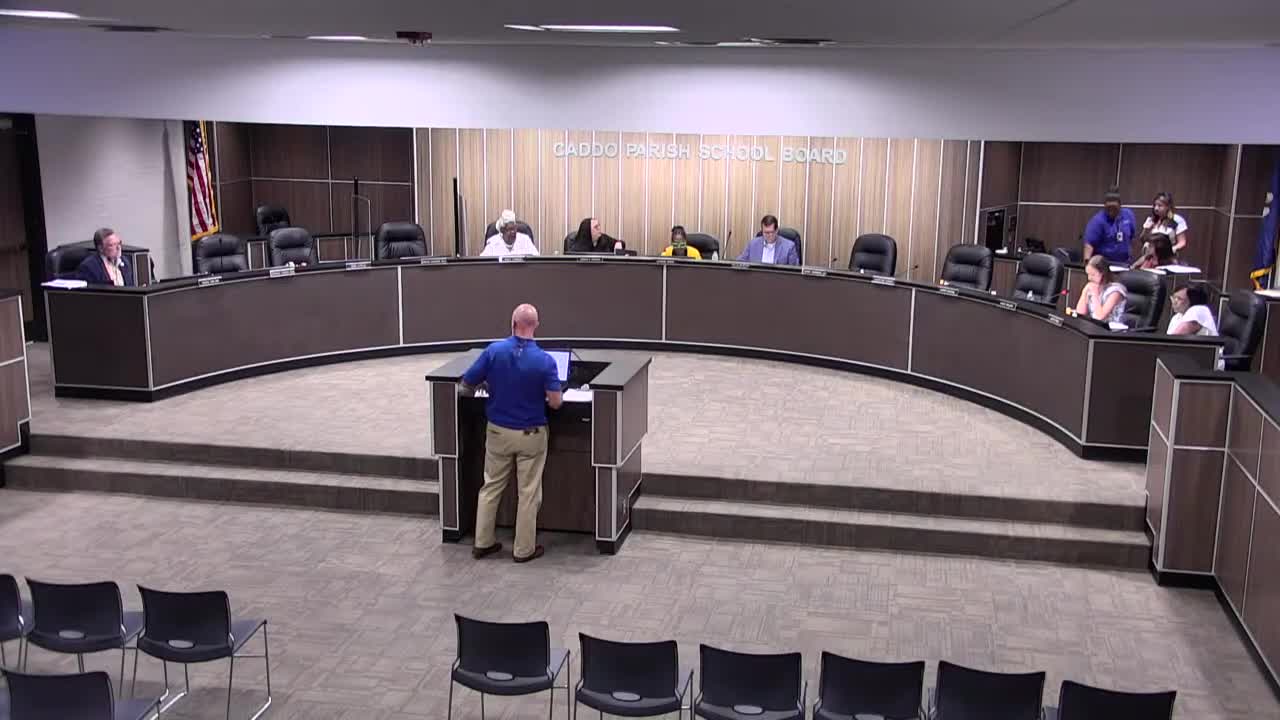
Summary
Caddo Parish Transportation Director Jeff Roberts told the school board’s Transportation Committee on July 1 that a mix of new hires, incentives, updated routing software and an expanded parent-facing communications platform aim to reduce breakdowns and improve on-time bus service for the 2025–26 school year.
Jeff Roberts, director of transportation for Caddo Parish Public Schools, told the Transportation Committee on July 1 that the district is pursuing new drivers, updated routing software and expanded parent communications to improve reliability for the 2025–26 school year.
Roberts said the department faces two recurring problems — staffing shortages and equipment failures — and described a plan focused on recruitment, culture and communications to address them. "I feel very optimistic that '25, '26 is going to be our best year yet in transportation," Roberts said.
The risk: summer heat can worsen bus air-conditioning failures
Roberts opened by warning that air-conditioning on school buses is a recurring equipment problem heading into August. He noted many bus AC systems are aftermarket vendor-installed units and that reliability varies by bus model. The district has 12 new buses at Plyler with newer AC systems, he said, and staff are working through the summer to reduce failures.
Why the staffing push matters
Roberts said recruitment is the top priority and highlighted a June 2 transportation-only job fair that drew more than 100 applicants. From that pool, the department ran a June training class that started June 13 with 28 candidates; of those, Roberts said 12 have learner permits and two already hold commercial driver’s licenses. The department plans a second summer class beginning July 17 with another 28–30 candidates.
Roberts provided several staffing figures: the district plans 250 bus routes at the start of the school year; it finished last year with 233 full-time drivers, added two drivers who moved from attendant roles (bringing the reported total to 235), and expects to be “almost at 250” drivers with trainees finishing certification. The board previously approved moving the number of full-time driver positions to 260, Roberts said, and the budget includes five return-to-work positions filled by retired drivers.
Recruitment and staffing changes are intended to give the department daily surge capacity — "hotshot" drivers who can cover breakdowns or return students home without routing the bus back to a school. Roberts said the extra drivers would be deployed across four geographic quadrants (Southwest, Southeast, Central and Northern) to improve on-time delivery.
Incentives and culture
Roberts described driver recognition programs piloted during testing windows and a new attendance-based incentive approved in the budget. Under the program, drivers can earn up to an additional $1,000 per year based on attendance — $250 per nine-week period — subject to a department policy that will define allowable absences.
Routing software and parent communications
Roberts said the district will migrate routing from the server-based Edulog/ESQL platform to Athena, a cloud-based update from the same vendor. He said Athena allows the department to run simulations in a sandbox and schedule changes to go live at specific times, which the district expects will improve optimization and flexibility.
On communications, Roberts outlined plans to expand the district’s use of K12 Insight’s Let's Talk platform and to adopt a new JCampus Connect parent app. He said Let’s Talk will be configured with topic buttons, FAQs and routing rules so messages are assigned to the correct staff member (for example, recruitment questions routed to Monique Dunn, the transportation recruiter). Roberts said the platform can reduce redundant work, create call-logs and generate monthly response-time reports for staff evaluation.
A demonstration from district staff showed how Cypress-Fairbanks Independent School District uses Let's Talk with a call-center add-on, including recorded phone dialogues, tagging to principals or supervisors, and dashboards that show queue length and agent availability. A district presenter said Caddo Parish has used Let's Talk since 2017 and the district will expand the product’s features for transportation.
Parent-facing features such as Find My Bus Stop
Roberts and other staff discussed how parents access bus-stop information and tracking. Roberts said Edulog currently does not allow parents to track buses in real time through the public interface, and that while the district’s systems have the technical capability for real-time tracking, the district has chosen not to enable parent tracking because of safety and custodial concerns: "We have the capability... We just do not," Roberts said, adding that schools can track buses internally.
He explained that the district asks drivers to submit route sheets after about a month of school so supervisors can determine whether stop times need adjustment. Roberts said the district expects some variance in stop times during the opening weeks and typically accepts a 15-minute window in AM and PM schedules; if a route proves to be consistently 25–30 minutes off, the team will consider schedule changes.
Operational details and future options
Roberts said fleet management will be selective about which buses remain in daily service and which are moved to a spare fleet; he said the department expects to support roughly 265 drivers in planning remarks while maintaining 30–35 spare buses (a figure he described as part of fleet planning), and that the garage and risk-management teams are coordinating insurance and decommissioning steps for surplus buses.
Board questions and next steps
Board members asked for clarifications on tracking, the timeline for Athena (September–October migration), the availability of JCampus Connect (described as an app that had not yet been released), and how Let's Talk will be presented to parents. Superintendent Burton said the app will allow communication regardless of whether the district has a current parental phone number on file.
Roberts said the department will continue to report progress, bringing updates on Athena and Let’s Talk and working with the communications office to publish tutorials and QR-code links for parents before school starts.
Ending
The committee did not take a formal transportation-specific vote during the presentation. Roberts' plan centers on filling driver positions, reinforcing a positive work culture, and expanding communications and routing tools to improve reliability in 2025–26.