Get Full Government Meeting Transcripts, Videos, & Alerts Forever!
Get email alerts on the Parish Budgeting topic
No spam. Unsubscribe anytime.
Finance staff outlines 2026 zero‑based budget plan, fund balances and hiring review
Summary
St. Tammany Parish finance staff summarized the 2026 budget process, announced a zero‑based approach for department requests, explained fund‑balance targets and reserves, described investment holdings, and said the administration will present the proposed 2026 budget to the council on Oct. 2.
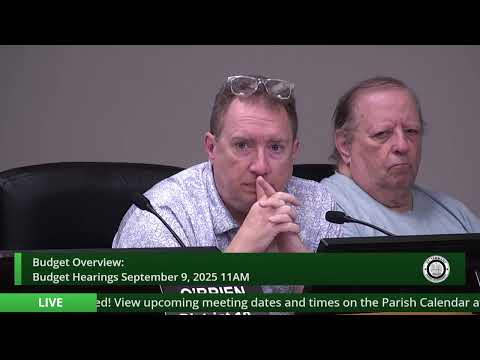
Annie (Finance department presenter) presented an overview of the St. Tammany Parish 2026 budget process to the finance committee, telling members the administration will deliver the proposed 2026 budget to the council on Oct. 2 and that departments were required to submit detailed, line‑item requests under a zero‑based budgeting approach.
The presentation said the finance department began the budget cycle in April and May, provided departments with standardized instructions and forms, and asked departments to justify all operating, payroll, capital asset and project requests. The goal, Annie said, is to ‘‘oversee taxpayer dollars wisely’’ and to spend funds “in accordance with any tax propositions or laws’’ while seeking efficiency.
Why it matters: the parish faces continuing pressure from state‑mandated criminal justice costs and a constrained general fund. Finance staff said the 2026 process is intended to surface all requests from scratch so the council and administration can choose priorities with clear, line‑item detail rather than rely on prefilled prior budgets.
Key points from the presentation
- Zero‑based entry and justification: For 2026 departments were asked to begin with zero in each budget line, then add only items they can justify. Supporting detail must include quantities, unit costs, descriptions and written justifications as well as projected 2025 year‑end spending. Departments were also required to submit five‑year capital plans even if they request no 2026 projects.
- Personnel direction: Administration instructed departments that no new positions or individual merit pay increases should be submitted in the 2026 requests; vacant positions would be reviewed case‑by‑case before approval. Annie described that stance as a ‘‘soft’’ position rather than a hard hiring freeze — critical operations such as water operators would be allowed to be refilled when needed.
- Capital and operating controls: Departments were told to request new or replacement equipment only when necessary, to evaluate useful life, and to consider repairs first. For central costs (facility square footage, insurance, fleet maintenance, HR salary and benefit inputs) finance provided standardized rates to departments to assure consistent entries in Munis.
- Munis and supporting documentation: Annie said the parish’s operating and payroll budgets are in Munis, but the system lacks some asset and position justification fields. Finance therefore requires supplemental forms and documentation for assets, positions and capital projects even if the monetary entries are in Munis.
- Timeline and process: Finance staff described iterative work with a cost‑allocation consultant over the summer, multiple reruns of allocations, and a plan to finalize files after the consultant’s last run. The proposed budget will be presented publicly on Oct. 2 with additional hearings in October; adopted budgets will be published and posted in Munis.
- Fund balance policy and reserves: Finance reviewed fund‑balance categories (nonspendable, restricted, committed, assigned, unassigned) and reiterated a general‑fund minimum target based on GFOA guidance: not less than two months of operating revenues or expenditures, though parish policy may set a higher target. The presentation cited a 2025 general‑fund minimum policy number of $12,700,000 and a projected available budgetary fund balance at year end of roughly $1,000,000; finance staff said the 2026 budget proposes using available balance to support state‑mandated costs.
- Investments and interest: As of July 31 finance reported approximately $245 million invested across custodial banks and agencies (Hancock Whitney, Stifel, Resource Bank and B1 Bank in the presentation). Holdings were concentrated in government agency securities and short maturities; fiscal‑year 2024 interest earnings were reported near $13 million (average portfolio return ~3%). Finance said the policy prioritizes safety, liquidity and then yield, and that most securities are held to maturity.
Committee discussion and clarifications
Councilmembers and staff asked for clarity on what the zero‑based approach means in practice (Annie explained savings show as increases to fund balance where applicable); on whether austerity directives applied to outside agencies (administration instructions applied to parish operating departments only, not independent agencies funded by separate millages); and on whether the council can lock in position freezes at adoption (the council has final budget authority and may consider amendments later). Several members encouraged giving the council read‑only access to Munis budget modules and seeking parish‑wide procurement economies (for example, consolidating copier contracts).
Annie said the finance department will host the cost‑allocation consultant at an upcoming finance meeting and will bring detailed fund‑balance numbers and policy discussion to later budget hearings. She also noted the need to examine long‑term maintenance costs for capital projects and to avoid relying on one‑time revenues for ongoing programs.
Ending: next steps
Finance staff said they will continue technical reviews, finalize the cost allocation runs, and present the formal proposed 2026 budget on Oct. 2 for council consideration. Departments should expect follow‑up from the finance office on any requested revisions and must complete the five‑year capital plan forms and supporting justification for assets and personnel.