Get Full Government Meeting Transcripts, Videos, & Alerts Forever!
Get email alerts on the Transportation topic
No spam. Unsubscribe anytime.
Committee reviews transportation plan, road classification work and complete‑streets tradeoffs
Summary
The committee discussed a draft master transportation plan that includes road reclassifications based on GPR scans, a candidate list for bond funding, and concerns about the cost and applicability of complete‑streets elements in the rural parish.
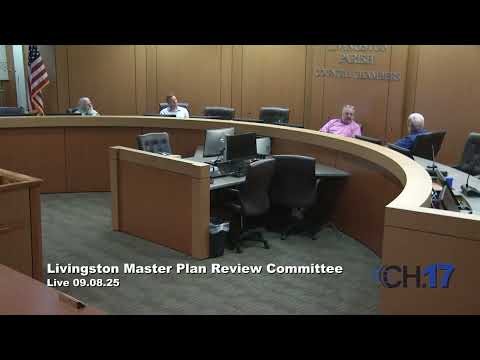
Members of the Livingston Parish Master Plan Committee reviewed the initial draft of a master transportation plan and discussed how the plan’s road classifications, bonding strategy and complete‑streets policies would be implemented.
The chair (name not specified) told members the parish has purchased detailed road scans (GPR) and that those data will be overlaid to help classify roads so the parish can compete for funding. The chair said the council and administration have earmarked candidate projects for bonding and that Jim Ryan (role not specified) would analyze bond timing to seek favorable market conditions.
Why it matters: road classification affects eligibility for state and federal grants; the parish’s backlog of roads and bond timing will influence how quickly repairs and new connections can be funded and built.
Committee members discussed key features of the draft transportation plan, including new connectors to reduce dead‑end streets, safety improvements at deteriorating intersections, and higher‑flow limited‑access corridors intended to move traffic across the parish. The chair said the plan includes projects already in progress by parish staff.
Members highlighted a recent machine‑driven road survey system that grades pavement condition (A/B/C/D) and noted the classification output is required to prioritize projects for bonding and outside funding. The committee asked for the list of candidate roads to be shared with members so they can do research and prepare input.
The group then discussed complete‑streets elements — sidewalks, dedicated bike lanes, multiuse paths, ADA‑compliant crossings and landscaping such as rain gardens. Several members said complete streets make sense in denser, municipal or suburban corridors but questioned applying full complete‑streets treatments uniformly across rural parish roads because of high costs, long time horizons for use, and limited grant funding.
One member explained tradeoffs between open‑ditch drainage and subsurface drainage: subsurface drainage allows narrower right‑of‑way for a given road cross‑section but costs more upfront. Members suggested a targeted approach: apply complete‑streets standards to municipally served corridors, evacuation routes, and areas slated for economic development while using simpler retrofit approaches elsewhere.
Ending: The committee did not take formal action. The chair said he will circulate the transportation plan materials to committee members and that the infrastructure committee and administration are coordinating bond planning; members asked staff to invite parish staff (Robert) to the next meeting to discuss technical details and funding lists.