Get Full Government Meeting Transcripts, Videos, & Alerts Forever!
Get email alerts on the Land Use Subdivision topic
No spam. Unsubscribe anytime.
Livingston Parish committee reopens minor-subdivision rules after drainage and floodplain concerns
Summary
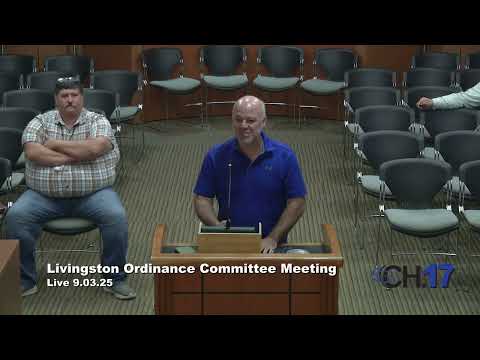
At a Sept. 3 meeting, the Livingston Parish Ordinance Committee reopened public comment on proposed changes to Section 125-37 on minor subdivisions after residents, drainage officials and engineers raised concerns about repeated resubdivisions, stormwater impacts and costs for small landowners.
The Livingston Parish Ordinance Committee on Sept. 3 reopened public comment on a proposed amendment to Section 125-37 governing minor subdivisions of property, focusing on repeated “minor resub” filings, drainage impacts and floodplain requirements. The item was placed back before the committee at the request of Councilman Wascom.
Committee members and public speakers said the proposed changes aim to close a perceived loophole that allows successive submittals of small resubdivisions, while others warned the draft could unintentionally burden small landowners who simply want to divide family property. "There was a loophole that's being used," said Councilman Ryan Shavers. "Developers and individuals are buying property and applying for a minor resub at 9 lots, and then they wait 2 years ... and they apply another 9. And that's what's happening."
Why it matters: Planning and drainage officials said the number of minor resubmissions has created review pressure and local flooding risks. Planner Scooter Keane and others told the committee that the planning office had received dozens of applications tied to the current rule. Engineering representatives and the gravity drainage district said the draft ordinance should include clearer triggers for drainage review and documentation so the parish can preserve Community Rating System (CRS) benefits and identify unnamed laterals that could become taxpayer maintenance burdens.
What was discussed: Several recurring themes emerged in public comment and staff discussion: - Scale and timing of resubmissions: Speakers noted the current practice allows repeatedly subdividing a parental tract over time. Several commenters urged limiting the number of lots in a minor resub or extending the time window between allowable resubmissions; one commenter suggested lengthening the time window from 24 months to 5 years. "Make it 5 years," said Eddie, a resident who spoke during public comment. - Lot-count threshold: Committee members and speakers debated using 6 lots versus 9 lots as the threshold that would trigger more extensive engineering reviews (drainage impact studies, traffic studies). Multiple speakers said lowering the threshold would catch the majority of iterative resubs while still permitting small family divisions. - Floodplain and CRS requirements: A planning-area speaker reminded the committee that FEMA/CRS rules require base flood elevation data for developments of 5 acres or more and urged the ordinance to include that requirement where applicable so the parish does not lose CRS points. Jamie Seal, an engineer with Quality Engineering & Surveying representing Drainage District 1, said the draft "absolutely goes a long way to help preserving those things as well," referring to floodplain protections and recent floodplain ordinance changes. - Practical, lower-cost screening: Commenters and staff proposed a tiered approach so small-scale, owner-occupied divisions would face lower-cost desktop reviews (using LIDAR and FEMA maps) while commercial-scale or sequential development would trigger full drainage impact studies. One speaker contrasted a "$1,000 drainage analysis" with a full "$15,000 drainage impact study." - Documentation and clearing permits: Drainage officials urged requiring clearing permits and early documentation (existing ground drainage, ditches, proposed runoff) before land clearing, to prevent loss of natural laterals and to give parish engineers data for review. - Servitudes and roads: Speakers recommended reserving 60-foot servitudes of passage where private roads may someday become public, and giving drainage districts the ability to review proposed servitudes so later conversion or maintenance costs are anticipated. - Utilities and lending: The committee discussed adding a requirement that subdividers show how electric, water and sewer would be provided for new lots; one speaker noted many banks will not finance lots larger than one or two acres and urged sensitivity to financing realities for homeowners. - Family partitions and exemptions: Several residents asked for a clear family-partition exemption that allows parents to give portions of a larger tract to children without triggering the full study requirements. Jeanette Clark and Melissa Jones referenced ordinances in neighboring parishes (Tangipahoa Parish and the City of Hammond were cited as models) that include family-partition language and longer resubmission windows.
What did not happen: The committee did not vote on the ordinance. No formal motion or adoption occurred; the session remained a public hearing and information-gathering meeting.
Next steps: The chair asked members of the public and stakeholders to submit written suggestions to the committee clerk, Raven, by 9 a.m. the following morning. Shavers said he would review submitted suggestions and revise the draft language for future committee consideration.
Community perspective: Multiple speakers said they support addressing the drainage and flooding problems created by some developments but asked the parish to avoid imposing high-cost requirements on elderly or low-income landowners who want to partition family property. "If somebody owns a 3- or 4-acre tract that was part of this original 6-lot resub, and they go to build a house, most banks don't lend on anything over an acre," said one commenter, arguing that heavy costs could block ordinary homebuilding.
The ordinance will return to the committee after staff and council members incorporate suggested edits and clarify thresholds, exemptions and specific triggers for engineering review.