Get Full Government Meeting Transcripts, Videos, & Alerts Forever!
Get email alerts on the Planning And Development topic
No spam. Unsubscribe anytime.
Council advances draft minor-resubdivision rules after members request narrow changes
Summary
Council moved a proposed ordinance tightening minor-resubdivision approvals back to the ordinance committee after members and residents called for clarifications on notification, grandfathering dates and administrative review thresholds.
The Livingston Parish Council opened public hearings Thursday and discussed a proposed ordinance (LP Ordinance 25‑19) that would change how minor resubdivisions are processed. The proposal would require additional studies — including drainage and traffic impact work — for parent tracts that have reached a threshold of previously subdivided lots, and it sets minimum lot-size and grandfathering dates for existing tracts.
Council members and staff said the planning office has a backlog of minor-resubdivision applications; the planning director reported roughly 41 applications in queue and multiple new filings arriving. Supporters of the ordinance described it as a tool to close a recurring loophole in which large‑acreage parcels were repeatedly split through minimal review to create many small lots without adequate infrastructure studies.
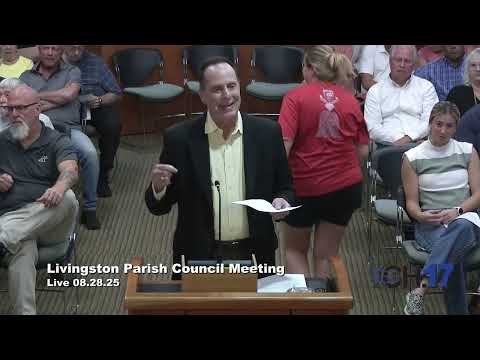
Public commenters supported a tighter process but urged clearer language and more transparency about incremental costs the ordinance could impose, especially for multi‑generation land transfers. One speaker, a certified public accountant, raised concerns that the incremental cost of required studies for the “seventh” lot could be substantial and should be advertised.
Council members agreed on a set of small changes on the floor: switching language so the planning director “may” (rather than “shall”) send a minor resub to Planning & Zoning where only drainage or road infrastructure is implicated, and updating the grandfathering date to reflect the council’s August 28, 2025 action so that the parish is not inadvertently penalizing recent legitimate subdivisions. The council voted to send the draft back to ordinance committee for editing with those amendments and further stakeholder review before adoption.
Why it matters: Planning staff said the proposed rules aim to require developers to pay for necessary drainage and traffic studies rather than relying on taxpayers later. Supporters said the change would protect neighborhoods from repetitive splitting that strains drainage, roads and public services; critics warned the studies could impose substantial costs on small landowners without careful exemptions.
The council instructed staff to return a revised draft that clarifies which applications go to Planning & Zoning, refines grandfathering language, and provides clearer administrative procedures for implementation.