
Board discusses Committee of Architecture role, covenant enforcement and new state law
Get AI-powered insights, summaries, and transcripts
Subscribe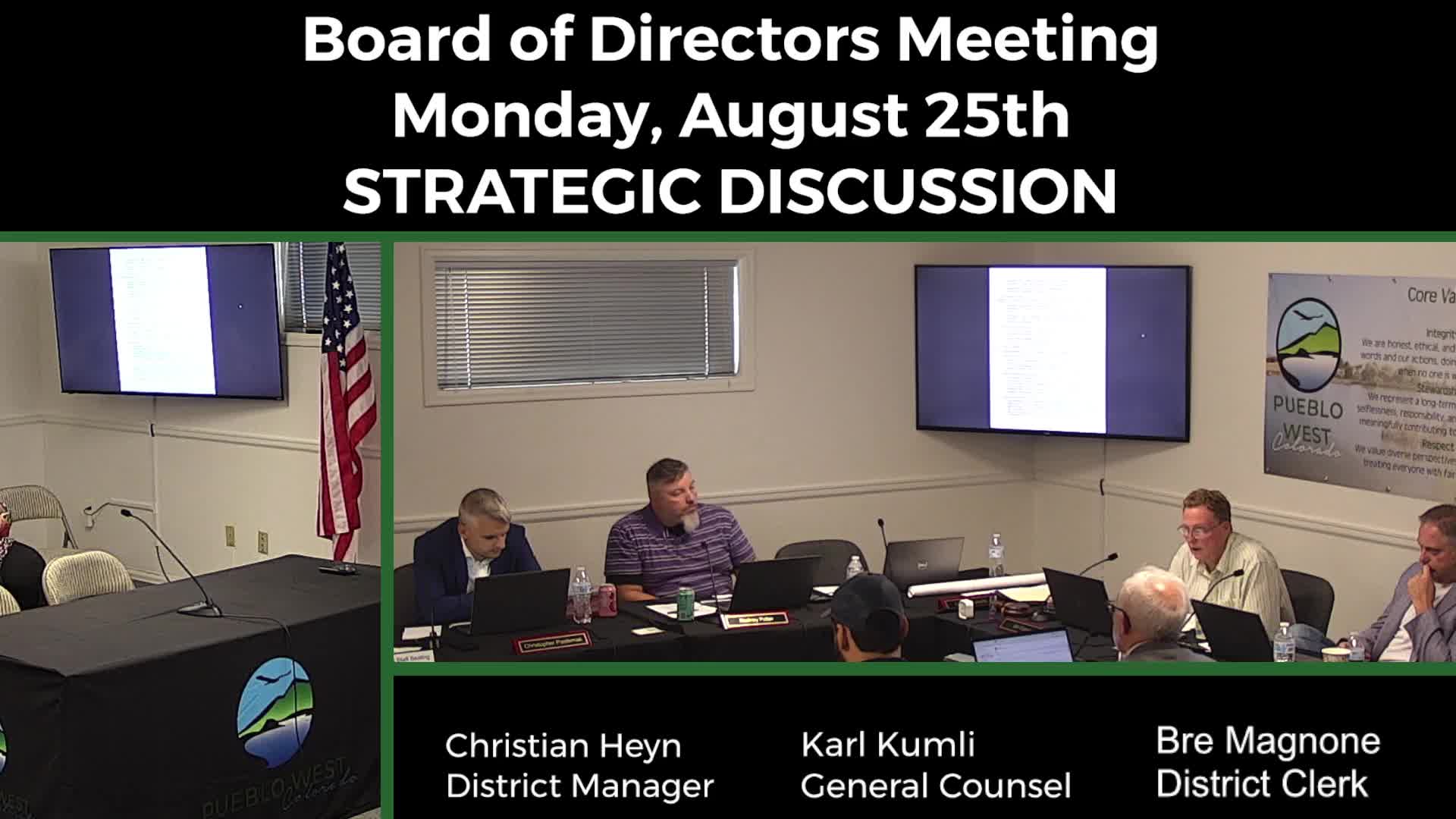
Summary
Directors reviewed the Committee of Architecture’s authority under the district’s declaration of reservations, recent state changes authorizing covenant enforcement for special districts, and options for clarifying the committee’s scope and board oversight.
PUEBLO WEST, Colo. — Board members and staff spent substantial time Aug. 25 reviewing the Committee of Architecture (COA), enforcement of covenants on district tracts, and whether COA authority exceeds its historical aesthetic-review role.
Board members traced the history of the COA from a private Triarch committee to district oversight and said the declaration of reservations gives COA a broad, subjective role to "provide for the maintenance of high standard of architecture and construction." The board and staff discussed whether COA should weigh in on matters beyond aesthetics — such as accessory dwelling units, home occupations, and sketch-plan review — and whether those items fall properly to planning, water or county zoning authorities.
Staff and board members noted that state law now more clearly authorizes metropolitan districts to enforce covenants in some contexts and requires a fining schedule. As one board member said, the state’s change “gave us the teeth in the covenant enforcement.” The transcript cites House Bill 24‑1267 (reported as "house bill 24 12 67" during the meeting) as the legislative change that clarified covenant enforcement authority for special districts.
Board members asked for a work session to review the declaration of reservations, COA bylaws, proper boundaries between COA and county planning, and what enforcement the district should exercise — especially for undeveloped tracks versus tracts that reach 90% build-out, at which point the declaration contemplates limits on COA enforcement.
Why it matters: the COA enforces covenants that affect many residents’ property appearance and rights, and clarifying its remit affects residents’ expectations, the district’s legal exposure, and how staff handle enforcement and appeals.
Ending: staff will schedule a work session with COA, planning and legal to draft recommended clarifications to the board on COA scope, due process, and where covenant enforcement is appropriate or should be transferred to tract-level homeowner groups.