Get Full Government Meeting Transcripts, Videos, & Alerts Forever!
Get email alerts on the Recreation Aquatic Center topic
No spam. Unsubscribe anytime.
Pueblo West board narrows aquatic center plan, reserves $6.2 million and directs lower‑cost design
Summary
After months of discussion the Pueblo West Board instructed staff to pursue a lower‑cost indoor pool design, authorize geotechnical borings and use $6.2 million currently set aside for an indoor aquatic center while reserving an additional $3.8 million for parks and recreation projects if a separate fire sales tax becomes permanent.
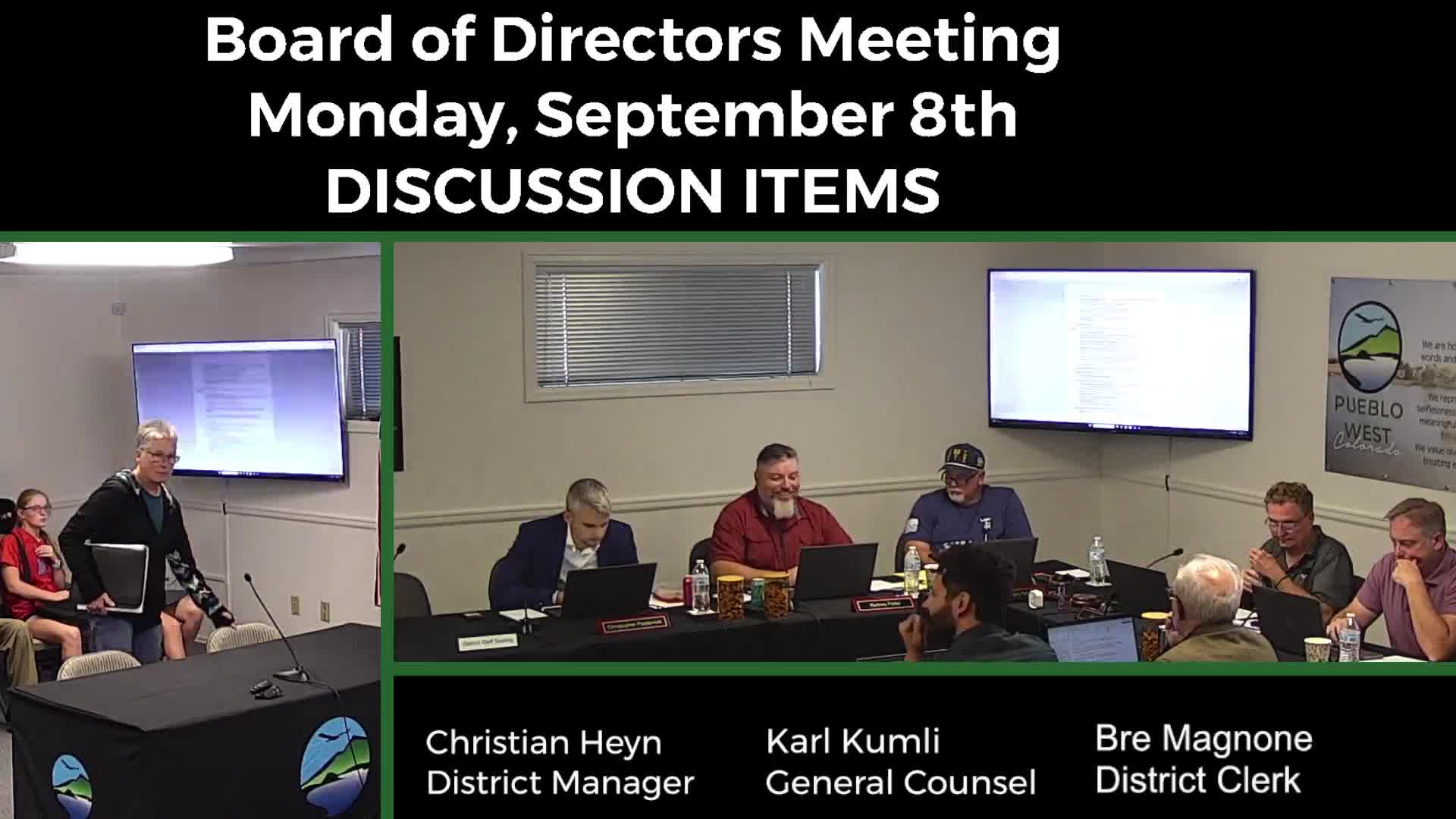
The Pueblo West Board of Directors voted Sept. 8 to pursue a lower‑cost alternative for the proposed indoor aquatic center, authorize geotechnical soil borings at two candidate sites and commit $6,200,000 currently set aside for the project while setting aside an additional $3,800,000 for future parks-and‑recreation facilities if the district’s 6A fire sales tax is made permanent. The board also directed staff to work with the district’s design consultant on a prefabricated/metal‑building option sized roughly 85 by 140 feet and to return cost and code analysis as they are developed.
Why it matters: The aquatic center has been in the district’s capital plans since the TABOR ballot language approved in 2016; rising construction estimates and long operating costs prompted the board to ask whether a smaller, less expensive indoor pool could meet community needs while reducing long‑term fiscal risk. The board’s action advances site testing and design work that staff said will inform a formal construction budget and future bidding.
Board discussion and direction: District manager Christian Hein and Parks and Recreation Director Carol Cosby briefed the board on project history, existing design work under contract and two site options under consideration. Hein said the district had an earlier 2021 contract for a larger, 18,000‑square‑foot facility budgeted at about $9 million; more recent reviews showed that cost estimates had grown and that a smaller facility might meet community priorities. President Vickers presented an alternate, smaller metal‑building concept intended to reduce cost and accelerate delivery. Staff reported Ascensa (design consultant) would perform geotechnical borings and produce a site‑specific soils report and an opinion of probable cost; the firm estimated 9–10 weeks to complete that work (target mid‑November).
Directors pressed for three things: 1) a clear decision on the long‑term vision (a modest indoor pool that can be expanded later vs. a full regional aquatic center); 2) a funding priority — whether the board wanted the lowest feasible construction cost or the best product the available budget could buy; and 3) timely geotechnical and traffic analysis so the board could select a site. Vice President Axworthy and other directors emphasized fiscal prudence; Director Vickers advocated delivering a facility that would be usable year‑round while limiting size and cost. Several directors noted operating costs remain a key unknown and cited prior district fiscal studies showing a likely annual operating subsidy for an aquatic center.
Formal action: The board first voted to reserve the $6,200,000 already collected for the indoor pool and to set aside an additional $3,800,000 for parks and recreation projects, to be released for construction or expansion if the 6A fire sales tax is made permanent. The board then approved a motion directing staff to pursue the alternate, smaller prefabricated/metal building concept (the Vickers alternative) and to have Ascensa adapt the current design to meet applicable codes (including the county’s adopted aquatic health/code requirements) and the $6.2 million program target. Directors voted to proceed with contract work on soils borings and related site evaluation as quoted by the design team.
Next steps and caveats: Staff will schedule geotechnical borings and laboratory testing on the two shortlisted sites, produce a soils report and a designer opinion of probable cost for the preferred concept (Ascensa estimated 9–10 weeks). The board asked staff to obtain foundation cost information tied to soils results, to estimate any roadway/traffic mitigation costs that would be needed for each site, and to return with a recommended site, refined cost estimate and a proposed professional services agreement before any construction‑level design or IFB. Board members repeatedly cautioned that construction estimates from a designer are opinions of probable cost and that the final cost would be set by competitive contractor bids.
Quotes: President Vickers, presenting the alternative design, said the smaller concept “gets us a pool, hopefully for quite a bit less money than what the $9,000,000 project is” and that a 12,000‑square‑foot cap was desirable. District manager Christian Hein described the choice for the board as “is it the lowest cost possible to preserve funding for future projects, or is it a set budget intended to achieve the most value within that budget?”
Ending note: Board members asked that staff prioritize completion of the geotechnical and site‑evaluation work so a site selection can be made and a construction funding plan be presented to the board. No construction contract was awarded at the meeting; the board’s permissions were limited to design direction, soils testing and committing the previously budgeted funds under the conditions adopted at the meeting.