Get Full Government Meeting Transcripts, Videos, & Alerts Forever!
Get email alerts on the Water Rates topic
No spam. Unsubscribe anytime.
Pueblo West hears Colorado Rural Water analysis showing fourth-tier rate and larger rate adjustments could close multi‑million dollar gap
Summary
District leaders and an outside consultant presented an informational analysis showing a fourth water‑usage tier plus proposed base and usage increases could add roughly $1.1 million to $3.1 million in annual revenue in model runs, while parcel‑level vegetation mapping could help target outdoor irrigation use.
District leaders and an outside consultant presented an informational analysis of Pueblo West’s water and sewer finances and a parcel-level vegetation mapping pilot that could help target outdoor irrigation use.
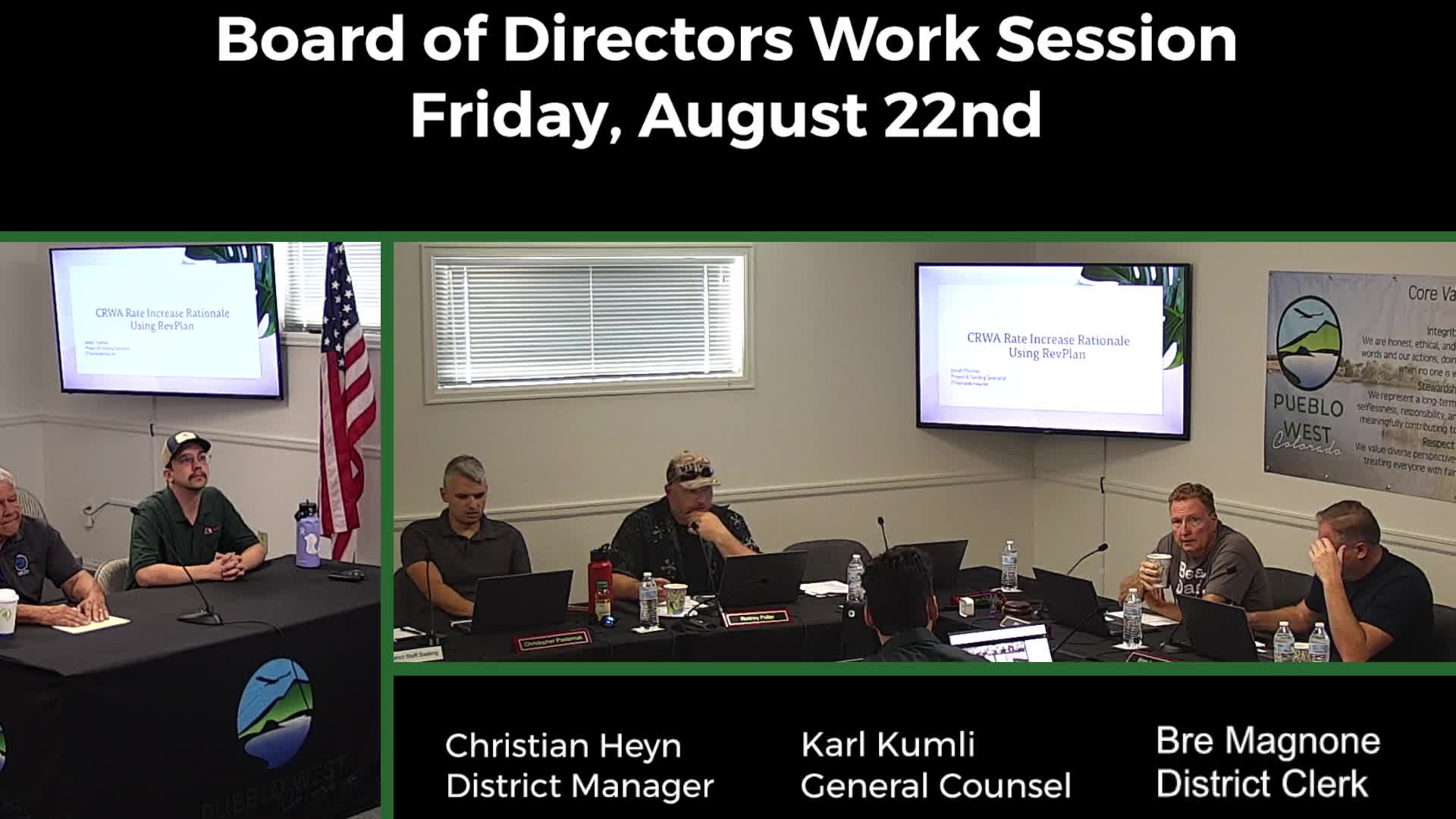
The most immediate topic was a rate-model briefing from Josiah Thomas of the Colorado Rural Water Association, introduced by Christian J. Hein, Pueblo West district manager, and Jim Blazing, director of utilities. Thomas said the model shows adding a fourth consumption tier — with the highest tier currently modeled at about "$9.46 a kilogallon" in his slide text — would increase revenue by roughly $1.1 million without other rate adjustments. Combining the fourth tier with proposed increases to base and usage charges (Thomas showed an illustrative 20 percent base‑charge increase and a 30 percent usage‑charge increase) could increase total revenue by roughly $3.1 million in the model presented.
Why it matters: presenters said the model is designed to meet common financial guardrails—debt service coverage over 1.2, reserves above roughly nine months of O&M, and revenue sufficient to cover operations and debt service—and to send a conservation price signal for outdoor use. The consultant stressed the briefing was informational, not a rate proposal to be decided at the session.
Key details from the presentation and board discussion: - Model inputs and guardrails: Thomas said he used reserves, existing debt, customer classes and usage, O&M budgets for fiscal 2023–24 and a 2025–2035 capital/operating plan, and the district’s current rate schedule. He described debt service coverage (target >1.2 ratio) and a reserve target of about 270 days of O&M as model constraints. - Revenue and budget figures discussed by staff: Jim Blazing and board members referenced budget lines shown in the packet and in the presentation — metered water sales budgeted near $9.2 million for 2025, plant investment fees (PIF) roughly $2.8 million, a water resource fee around $500,000 and tap fees around $260,000. Water enterprise operating expenses (excluding capital) were cited near $10 million; wastewater operating expenses (excluding capital) near $3.5 million with sewer revenue about $4.6 million. - Capital and reserves: staff noted a roughly $28 million capital allocation for the current year that the consultant did not fully include in the long‑term reserve model; presenters said large current‑year capital spending will draw reserves and could require borrowing for future projects if reserves are used down. - Rate outcomes and scenarios: Thomas presented four model runs. The “4th tier only” scenario increased revenue ~ $1.1 million; a 4th‑tier plus rate adjustments scenario increased modeled revenue by roughly $3.1 million. He said the model is malleable and thresholds or rates can be adjusted. - Conservation and usage mapping: Thomas and staff described a parcel‑level vegetation and canopy mapping pilot using satellite imagery and NDVI (normalized difference vegetation index) to estimate outdoor irrigation. Staff showed the pilot mapped the golf course and adjacent parcels and said the map can be used to estimate outdoor use parcel by parcel and inform targeted conservation or budgets. - Board questions: members asked how ongoing conservation would affect revenue (Thomas: lower usage reduces revenue but also frees taps and could be modeled to maintain target coverage by adjusting thresholds); whether large current capital expenditures were accounted for (answer: not fully in the consultant’s run; the model can be updated); and how long a rate increase would be sustained (presentation suggested an initial larger increase followed by lower annual adjustments in the model).
What the board asked staff to follow up on: several board members said the district should communicate clearly to the public what a fourth tier means, give concrete examples of what 30,000 gallons a month represents, and show a Gantt or similar schedule tying the capital projects to the reserve and rate assumptions. The consultant offered to produce additional scenario runs that show the revenue impact if conservation reduces usage.
Ending: staff said the presentation and model would be used as a basis for developing a formal proposed rate package and public hearing process if the board directs that next step. Presenters and staff also recommended follow‑up materials for public outreach (example bills, the parcel vegetation map, a Gantt showing project timing and funding sources).