Get Full Government Meeting Transcripts, Videos, & Alerts Forever!
Get email alerts on the Water Policy Graywater topic
No spam. Unsubscribe anytime.
Board weighs response to gray‑water bill; staff recommends county limit use to protect water accounting
Summary
After staff briefed the board on House Bill about gray‑water systems, staff recommended the district ask Pueblo County not to permit unrestricted on‑site gray‑water reuse because of potential cross‑contamination and impacts to return‑flow accounting that affect the district's water rights and reuse credits.
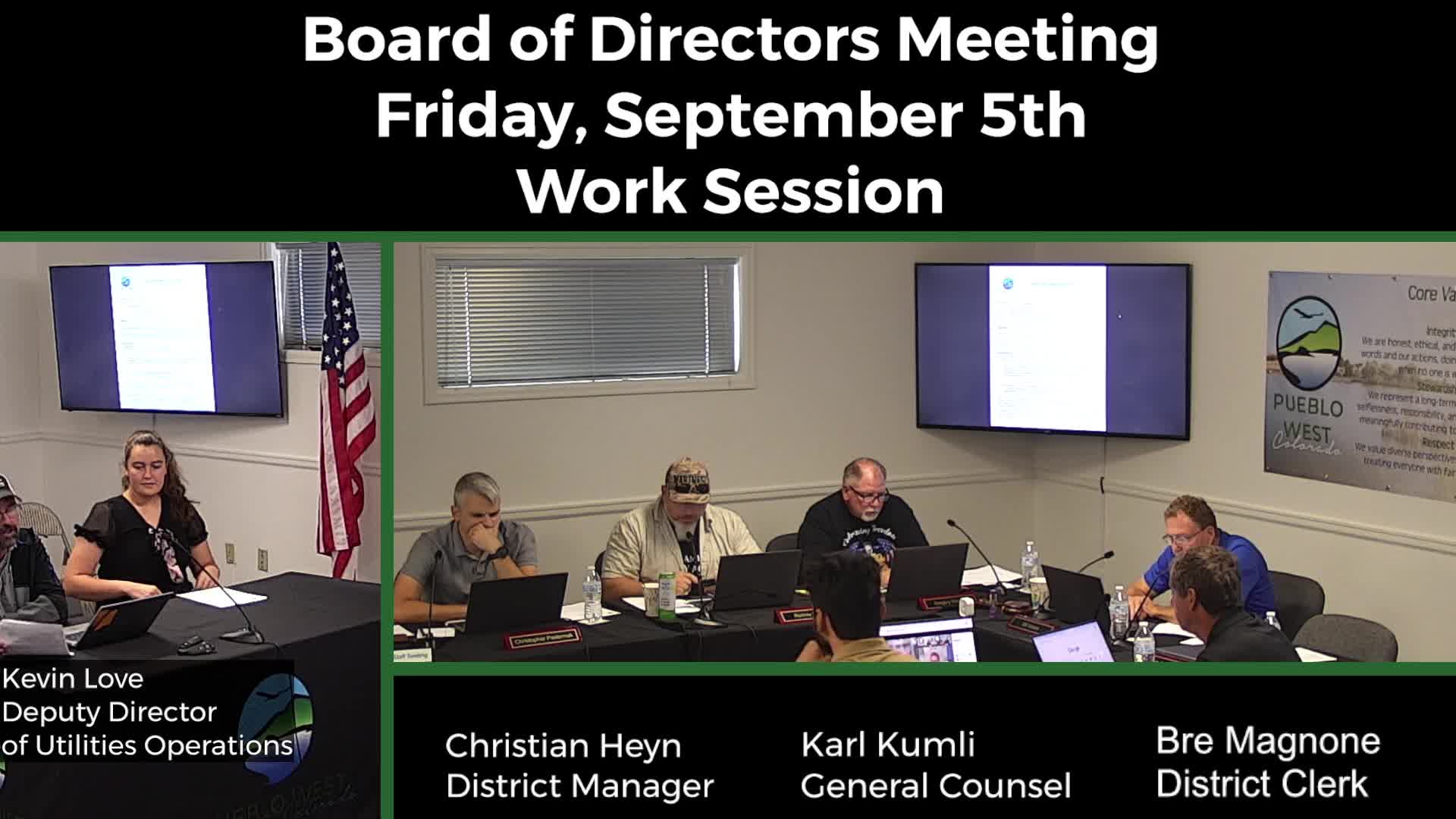
At a Pueblo West Metro District work session staff asked the board to consider taking a position on House Bill concerning on‑site gray‑water systems and whether Pueblo County should allow them. Anna and Elisa Velasquez (Water Resource Manager) explained potential public‑health and water‑accounting concerns and recommended the board consider sending a letter to county commissioners.
Elisa Velasquez said an individual homeowner’s gray water—water from sinks or laundry reused for irrigation—would not be treated before reuse and could pose “safety concerns” if misused. “That water is not being filtered in any way before it's being used again on the lawn,” Velasquez said. She added staff’s concern is less about immediate health impacts and more about incorrect or unsafe implementations by residents.
Staff and legal counsel Carl briefed the board on the bill’s drafting and water‑accounting implications. Carl described the statute as ambiguous and noted it vests permissive authority in counties even though counties are not water providers. He said the language is “badly drafted” with respect to metro districts and recommended the district seek clarification or ask the county to consult with water providers and the state engineer before authorizing widespread gray‑water use.
Carl focused on water rights and return‑flow accounting rather than public‑health effects. He said that treated reuse that returns through the district’s wastewater treatment and then is treated at the water plant poses different accounting consequences than on‑site reuse that would bypass treatment and reduce return flows to streams. “The issue for water providers… is that it changes how much we get back and would cause some legal issues that we might have to go back and specify,” Carl said. He advised more fact finding on likely gray‑water volumes and consultation with the state engineer before a formal policy or county position is adopted.
Board members expressed varying views. Director Roberts and other board members said a blanket prohibition could be unnecessarily restrictive; Roberts recommended careful investigation and not an immediate blanket “no.” Another board member suggested the county lacks the technical expertise and that the district should press the county to defer to water providers on technical regulation.
Staff said the board will receive a staff report and a recommended letter for the Monday meeting; the county retains final authority under the statute, and the staff recommendation is procedural: to ask the county not to authorize gray‑water systems without consultation on water‑accounting and public‑health safeguards.
Ending: Staff will prepare a draft letter and staff report for the board’s Monday meeting with suggested language reflecting the district’s concerns about statutory ambiguity, water‑accounting impacts, and the need for county coordination with the state engineer and water providers.