
Pueblo West utilities department details 2025 water, wastewater and capital projects
Get AI-powered insights, summaries, and transcripts
Subscribe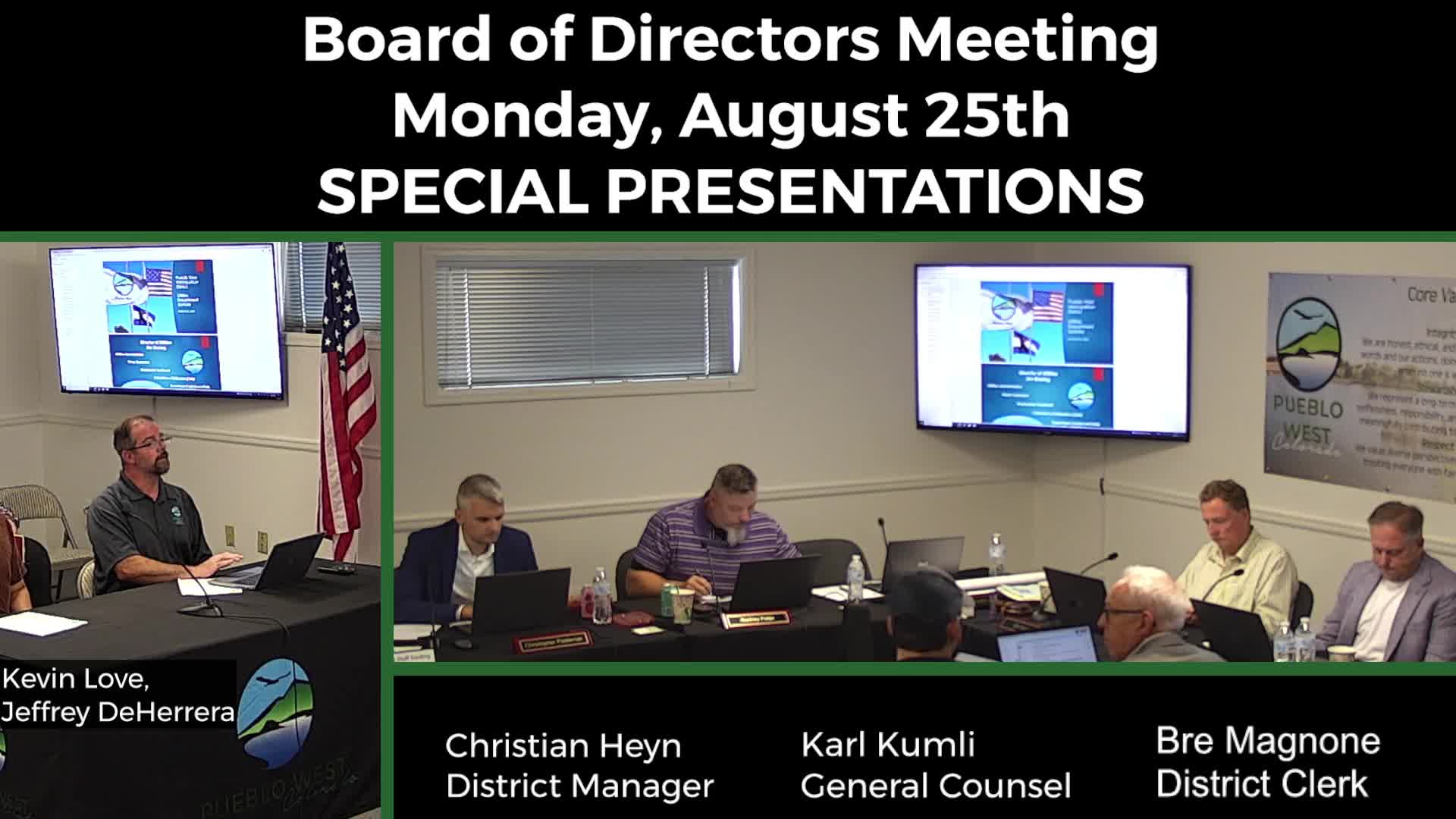
Summary
Department leaders updated the Pueblo West Metropolitan District board on 2025 water consumption, taps, well testing, treatment-plant upgrades and a suite of distribution and collection projects now in design or construction.
PUEBLO WEST, Colo. — The Pueblo West utilities department told the board Aug. 25 that water consumption and a slate of projects remain central to operations and capital planning for 2025. Director of Utilities Jim Blazing and deputy directors outlined staff, recent work and next steps for wells, treatment, distribution and regional collaboration.
Blazing opened the presentation, saying, “Good evening, president Figgers and the board members. We're the utilities department, and we're here to give you a brief update of 2025.” The report covered administration and billing, water conservation work, water-rights administration, and partnerships with neighboring water entities.
Why it matters: the department manages supply and treatment systems the district relies on, and several projects under way — from transmission mains to well development and clarifier rehab — will affect service reliability and capital budgets.
Department leaders said year-to-date statistics show 130 taps “spoken for” with 96 paid; an updated figure for year-to-date water consumption was reported as 3,434 (units presented as in the briefing). Deputy director Jeffrey de Herrera credited water conservation outreach and programs, and named staff who handle billing, conservation and resources.
On treatment, deputy director Kevin Lev said August’s average raw-water demand was about 7.7 million gallons per day and noted recent and ongoing equipment rehabilitation: clarifier and filter rehabs (filters 6–8 completed; filters 5 and 11 in progress), media installs and PLC upgrades to replace obsolete controllers. He said staff were “reevaluating some of our chemical supplies to identify operational cost savings and increase our efficiency.”
Wastewater staff reported year-to-date totals of 312.9 million gallons treated in 2025 and an average daily treatment of about 1.35 million gallons per day. The department is pursuing upgrades with consultant JBA, completed a rebuilt return activated sludge pump (RAS), upgraded a PLC at the plant, and completed a digester blower-drive replacement.
On distribution, staff reported 13 repaired main breaks this year, start of a 16-inch Purcell transmission main project in mid-August, completion of Track 337 water-main design (mobile-home area), and PRV design ready to go to bid. An inflow-and-infiltration (I&I) study is underway to reduce collection-system demand. SCADA upgrades and standardization, including radar sensor filter-level monitoring, were also reported.
Officials described regional collaboration with the Twin Lakes Reservoir Canal Company, the Southeastern Colorado Water Conservancy District and both Upper and Lower Arkansas water conservancy districts; Blazing said the district is budgeting a feasibility study with the cities of Florence and Cañon City for the Oak Creek Reservoir project and referenced a passed board resolution for a nearby recovery-of-yield reservoir project.
Board members asked whether August demand was up or down from historical levels; Lev said it is “down,” noting years when the system pushed above 10–12 MGD. In response to a question about the split between raw water pumped and wastewater treated, staff said outdoor irrigation and seasonal use are major drivers of the difference.
Ending: department leaders said they are monitoring chemical and safety improvements (including chlorine handling), tracking project schedules across many design and construction phases, and continuing public outreach on water conservation.