Get email alerts on the Transportation Missouri 47 topic
No spam. Unsubscribe anytime.
Panel advances Missouri 47 corridor study, seeks 50/50 cost share and federal grants
Summary
The Washington Area Highway Transportation Committee on June 30 reviewed a corridor study for Missouri Route 47 and agreed to support an application for a MoDOT 50/50 cost share while pursuing federal grants.
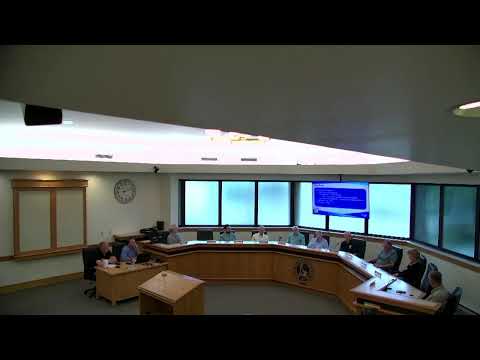
The Washington Area Highway Transportation Committee on June 30 reviewed a corridor study for Missouri Route 47 and agreed to support an application for a 50/50 cost share to the Missouri Department of Transportation (MoDOT) while pursuing additional federal grant options.
Committee members heard a presentation from Jordan (project presenter), with project manager Aaron and consultant Carrie on the study’s purpose, timeline and initial recommended alternatives. Jordan said the study covers the Route 47 corridor from Missouri 100 to I‑44, a 12.7‑mile corridor targeted for potential construction in fiscal year 2028. ‘‘This partnership is going to add essentially $12,000,000 to the project that we already have stated for fiscal year ’28,’’ Jordan said.
The committee was briefed on four high‑level cross‑section options under study: (1) four lanes (undivided/divided), (2) three lanes with a center two‑way left turn lane, (3) a two‑lane divided roadway with intermittent U‑turn or J‑turn provisions, and (4) retaining two lanes with widened shoulders. Presenters said the analysis uses peak‑hour traffic data and projections developed with MoDOT and East‑West Gateway. Aaron noted that a typical two‑lane undivided cross section can handle roughly 28,000 vehicles per day at a high level, while two‑lane divided and three‑lane sections offer more capacity because they reduce left‑turn conflicts.
Safety, right‑of‑way needs and costs were central to the discussion. Carrie said right‑of‑way acquisition is a major cost driver and that a four‑lane alternative would require substantially more takings than narrower sections. The presenters emphasized safety tradeoffs: a three‑lane section with a center turn lane typically improved safety versus existing conditions by giving turning vehicles a place to wait, while four lanes could reduce travel time but raise crash risk by increasing vehicle speeds and side‑impact opportunities.
The committee also reviewed intersection strategies. Jordan and the consultants described signalized and unsignalized treatments, roundabouts and alternative high‑capacity designs such as continuous flow intersections (CFI) and diverging diamonds. Jordan said a CFI at the 47/50 junction would meet projected traffic into 2050 with ‘‘very minimal right‑of‑way taking’’ compared with building a bypass alignment.
On funding and next steps, Darren (committee chair) reported that the City of Washington and Franklin County have executed an intergovernmental agreement to pursue a MoDOT 50/50 cost share for the first 4,000 feet south of the city limits. The committee discussed pursuing Surface Transportation Program (STP) funds after the 50/50 decision and also evaluating a Congestion Mitigation and Air Quality (CMAQ) application. Jordan said the STP local share would be 20 percent (approximately $1,200,000 of a $6,000,000 local share example) and the committee would discuss cost‑sharing splits between the city and county if the STP award is granted.
Committee direction and public outreach steps were recorded: the project team will hold a third Community Advisory Group (CAG) meeting in August, then a public meeting to present refined alternatives. Jordan said the team will continue to coordinate with neighboring municipalities (Union and St. Clair) about potential cooperative applications. Darren read a letter of commitment into the record and said he signed it as chairman: ‘‘Washington Area Transportation Committee is in full support of the proposed Highway 47 improvements as presented at our last meeting.’’ He said the signed letter will accompany the 50/50 cost‑share application to MoDOT.
The committee also reviewed technical findings: projected 2024 and 2050 average daily traffic (ADT) figures across segments, pavement core results indicating areas needing 4–6 inch mill‑and‑fill work, spot speed studies showing drivers exceed posted limits in off‑peak hours, and frequent public input favoring narrower footprints with safety improvements. Presenters reiterated that peak‑hour (AM/PM) analyses drive capacity recommendations and that the PM peak is the corridor’s worst case.
The project team will continue conceptual design, refine cost estimates and right‑of‑way needs, incorporate public and CAG feedback, and pursue the sequence of funding steps: 50/50 cost share, STP application, and potential CMAQ submittal where applicable. A third CAG meeting is scheduled for August, followed by a public meeting to display alternatives.
The discussion closed with committee members encouraging outreach to other municipalities and cautioning that a bypass alignment would likely require additional partner commitments for funding.
AI generated
The text on this page is AI generated. Summaries, highlights, analysis, and video transcripts are all produced from the original source material.
AI can make mistakes, so if you spot one, and we will fix it for everyone.
Note: the source content is unaltered by us. Any content source we link to, be it a video, an audio recording, or a document, is presented exactly as its publisher released it. That publisher is usually a government body, sometimes an individual official or another organisation.